12
Pharmacokinetic Studies: The Real Story Behind Generic Drug Equivalence

When you pick up a generic pill at the pharmacy, you assume it works just like the brand-name version. But how do we really know? The answer lies in pharmacokinetic studies-the backbone of generic drug approval. Yet, calling them the "gold standard" is misleading. They’re not perfect. They’re not always enough. And for some drugs, they might even be the wrong tool entirely.
What Pharmacokinetic Studies Actually Measure
Pharmacokinetic studies track how your body handles a drug. Not whether it cures your infection or lowers your blood pressure. Not whether it’s safer. Just: how much of the drug gets into your bloodstream, and how fast.
The two numbers that matter most are Cmax (the highest concentration in your blood) and AUC (the total drug exposure over time). These are measured by taking blood samples from healthy volunteers after they take the generic and the brand-name drug. The goal? Prove the generic delivers the same amount of drug, at the same speed.
The FDA requires the 90% confidence interval for both Cmax and AUC to fall between 80% and 125%. That means if the brand drug gives you 100 units of exposure, the generic can range from 80 to 125 units-and still be considered "equivalent." For most drugs, that’s wide enough to allow for normal biological variation. But for drugs with a narrow therapeutic index-like warfarin, digoxin, or phenytoin-the limits tighten to 90-111%. One wrong dose can mean a stroke or a seizure.
Why These Studies Are the Default, Not the Gold
The system was built in 1984 with the Hatch-Waxman Act. Before that, generic manufacturers had to run full clinical trials. Too expensive. Too slow. So Congress said: if you match the active ingredient, dose, and delivery method, just prove your drug behaves the same in the body. No need to re-prove it works for every condition.
That’s efficient. And for 95% of generic drugs approved by the FDA in 2022, it works. But the FDA itself says bioequivalence isn’t a "gold standard." It’s a surrogate. A proxy. A shortcut.
Think of it like testing two cars. You don’t need to drive them both up a mountain to know if they have the same engine. You just check the fuel flow, air intake, and exhaust output. If those match, you assume the performance is the same. But what if one car has a better transmission? Or a faulty sensor? The fuel numbers look fine. The car still runs. But it doesn’t handle the same.
The Hidden Flaws: When the Numbers Lie
Here’s the uncomfortable truth: two generics can have identical pharmacokinetic profiles-and still behave differently in real patients.
A 2010 study in PLOS ONE looked at generic versions of gentamicin, an antibiotic. All passed the standard bioequivalence tests. Same Cmax. Same AUC. Same manufacturer reputation. Same lab results. But when doctors used them in hospitals, some patients had treatment failures. Others had unexpected side effects. The in vitro tests said they were identical. The blood tests said they were identical. But the clinical outcome? Not.
Why? Because pharmacokinetic studies measure what happens in the bloodstream. They don’t measure what happens at the infection site. They don’t measure how the drug interacts with bacteria. They don’t measure how your liver metabolizes it differently under stress.
For complex drugs-like extended-release pills, inhalers, or topical creams-the story gets even messier. A cream might deliver the same amount of drug into the blood, but if it doesn’t penetrate deep enough into the skin, it won’t treat eczema. A slow-release pill might release the same total amount over 24 hours, but if it dumps half the dose in the first two hours, it can cause nausea or toxicity.

What Happens for Topical and Complex Drugs?
For oral pills, blood tests make sense. For creams, ointments, or nasal sprays? Not so much.
Trying to measure drug levels in the blood after applying a steroid cream is like trying to measure how much paint got into the air after you brushed a wall. Most of it stays where you put it. The blood levels are meaningless.
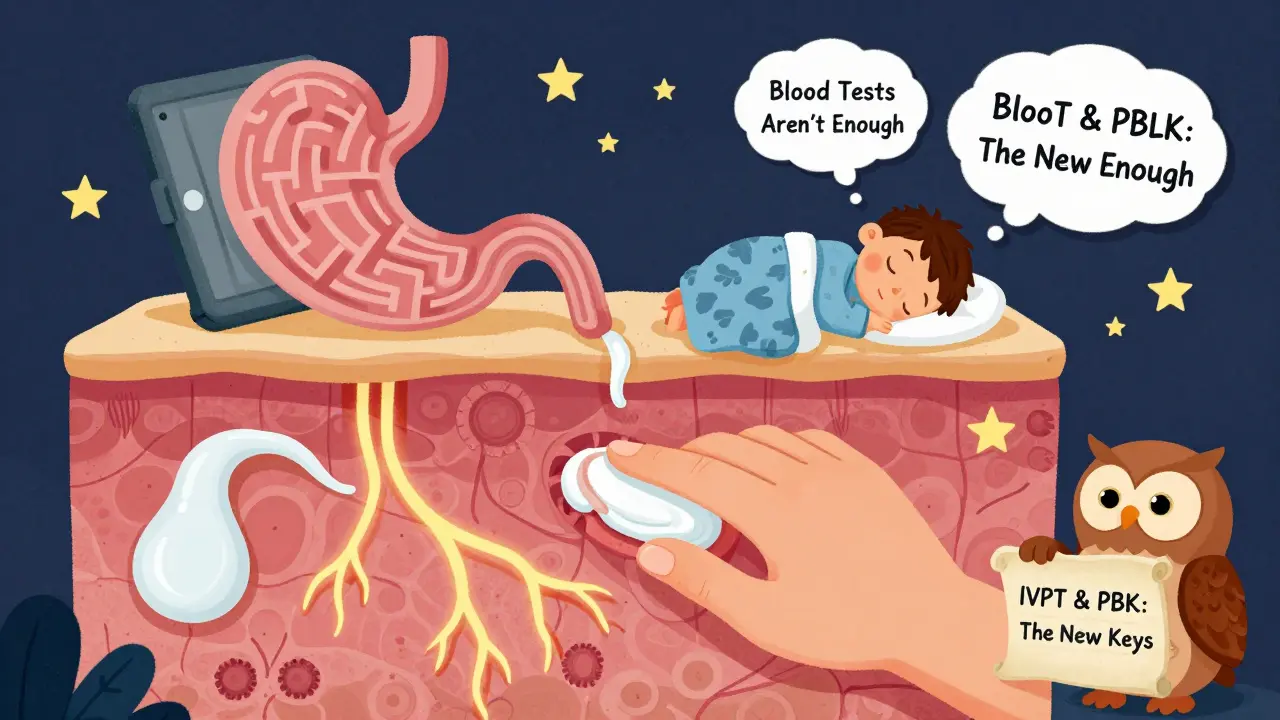
So what do regulators do? They use in vitro permeation testing (IVPT). This means testing how the drug moves through human skin in a lab dish. Some labs use cryopreserved human skin samples. Others use synthetic membranes. The goal? Match the release profile of the brand product exactly.
A 2014 study by Lehman and Franz showed IVPT was more accurate-and far less variable-than trying to run clinical trials with hundreds of patients. The FDA now accepts this for many topical products. The WHO does too. But it’s still not the norm everywhere.
And for inhalers? They use aerosol particle size testing. For injectables? They check viscosity and stability. Each drug class has its own rules. There’s no one-size-fits-all.
The Real Cost and Complexity
Running a bioequivalence study isn’t cheap. It costs between $300,000 and $1 million. Takes 12 to 18 months. You need 24 to 36 healthy volunteers. They have to fast. They have to come back for multiple blood draws. You test them both fasting and after eating-because some drugs absorb totally differently with food.
And even then, you’re not done. The FDA has over 1,800 product-specific guidances. Each one tells manufacturers exactly how to test their drug. One drug might need a crossover study. Another might need a fed study. A third might need a special dissolution test. And if your drug is a modified-release tablet? Good luck. A tiny change in the coating or filler can throw off the release profile. You’ll have to redo the whole study.
That’s why many generic companies skip complex drugs. They’re too risky. Too expensive. Too unpredictable. The market is full of simple, high-volume generics. But the drugs that need them most-like NTI drugs or biologics-are often left behind.
The Future: Beyond Blood Tests
The field is changing. Fast.
Physiologically-based pharmacokinetic (PBPK) modeling is now accepted by the FDA. This means using computer simulations to predict how a drug behaves in the body-based on its chemistry, your anatomy, your liver enzymes. For certain BCS Class I drugs (fast-absorbing, highly soluble), companies can now skip human trials entirely. They just run the model. If it matches the brand, they get approval.
And for topical drugs? Dermatopharmacokinetic methods (DMD) are gaining traction. These use microdialysis probes or tape stripping to measure drug levels directly in the skin. One 2019 study showed DMD could detect differences between formulations with over 90% accuracy-something blood tests could never do.
Even in vitro dissolution testing is being rethought. If two tablets dissolve within 10% of each other in a lab solution, they’re considered equivalent. But real stomachs aren’t lab solutions. They vary by pH, food, motility, and even gut bacteria. New methods are starting to simulate real human digestion-not just water in a beaker.
What This Means for You
If you’re taking a generic for high blood pressure, asthma, or depression? You’re almost certainly fine. The system works for most drugs. The odds of a problem are less than 2%.
But if you’re on warfarin, thyroid medicine, or seizure drugs? Pay attention. Talk to your pharmacist. Don’t switch brands unless you have to. Even small changes in absorption can throw off your dose. Keep a log. Watch for symptoms. Your doctor should monitor your levels more closely.
And if you’re a patient who’s been switched multiple times? You’re not imagining things. There’s evidence that some generics-even those that pass regulatory tests-can behave differently in real life. It’s not about quality. It’s about complexity. The science isn’t perfect. And the regulators know it.
The truth? Pharmacokinetic studies aren’t the gold standard. They’re the baseline. The starting line. The most practical tool we have. But they’re not the finish line. Not for all drugs. Not for all people.
Are generic drugs always as effective as brand-name drugs?
For most drugs, yes. The FDA approves over 95% of generics based on pharmacokinetic studies, and post-market data shows failure rates below 2%. But for narrow therapeutic index drugs-like warfarin, digoxin, or phenytoin-even small differences in absorption can matter. If you’ve had issues switching generics, talk to your doctor. Not all generics behave the same, even if they pass regulatory tests.
Why do some people say generic drugs don’t work as well?
It’s not always placebo. Some patients report differences in side effects or effectiveness after switching generics. This can happen because of differences in inactive ingredients, release rates, or how the drug is absorbed. Pharmacokinetic studies measure blood levels, not how the drug works in your body. For complex formulations-like extended-release pills or topical creams-these studies may miss real-world differences.
Do all countries use the same standards for generic drug approval?
No. The FDA and EMA have different approaches. The FDA uses product-specific guidances-meaning each drug has its own testing rules. The EMA tends to use a more uniform approach. The WHO supports international alignment, but implementation varies. In some countries, especially emerging markets, testing may be less rigorous, and quality control can be inconsistent. Always check the manufacturer and regulatory body behind your medication.
Can in vitro tests replace human pharmacokinetic studies?
For some drugs, yes. The FDA now accepts in vitro dissolution testing and physiologically-based pharmacokinetic (PBPK) modeling to waive human trials for certain BCS Class I drugs. For topical products, in vitro permeation testing (IVPT) with human skin is often more reliable than blood tests. But for most oral drugs, human studies are still required. The choice depends on the drug’s properties-not a one-size-fits-all rule.
How much does a bioequivalence study cost, and how long does it take?
A typical bioequivalence study costs between $300,000 and $1 million and takes 12 to 18 months from start to finish. It involves 24-36 healthy volunteers, multiple blood draws, and testing under both fasting and fed conditions. For complex drugs, additional testing and regulatory review can push costs higher and timelines longer.