1
Supply Chain Economics: How Generic Drug Distributors Achieve Efficiency Under Pressure
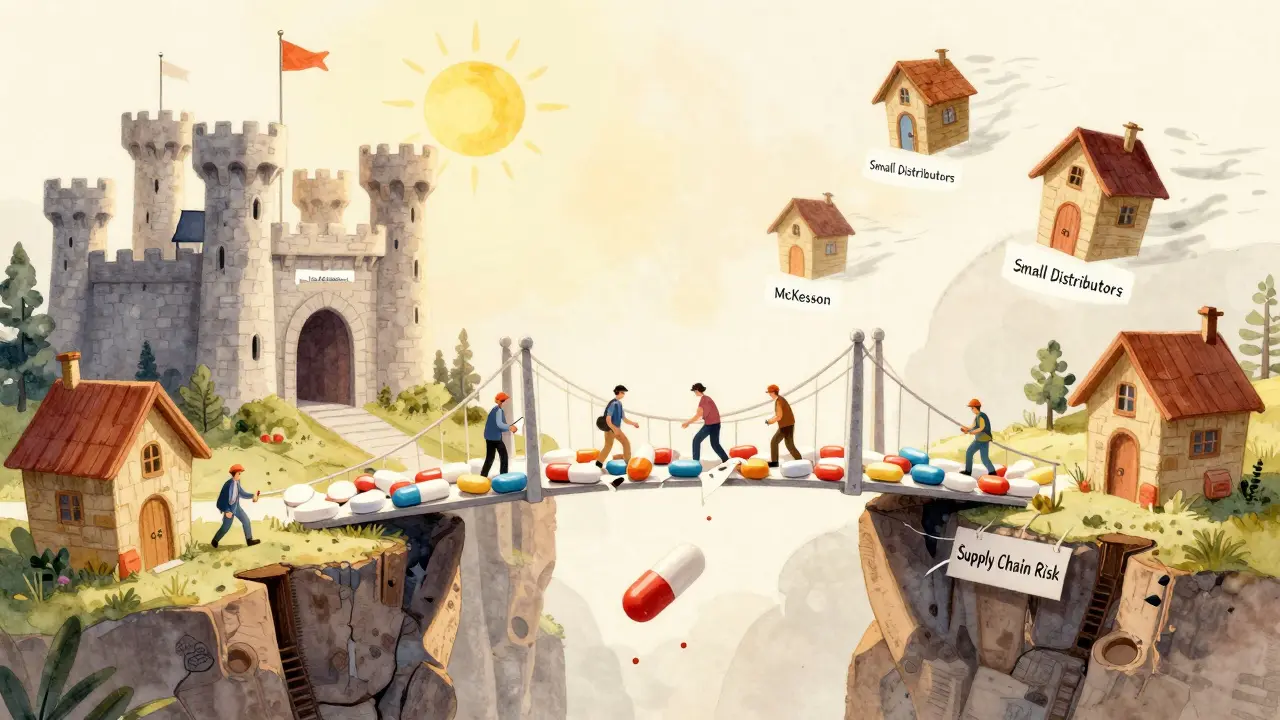
Generic drugs make up 90% of all prescriptions filled in the U.S., but they account for just 20% of total spending. That’s the paradox: generic drug distribution is the backbone of affordable healthcare, yet it operates on margins so thin that one supplier delay can trigger nationwide shortages. This isn’t about fancy logistics-it’s about survival. When a generic antibiotic or blood pressure pill disappears from shelves, it’s rarely because no one makes it. It’s because the supply chain was built to squeeze out every penny, leaving no room for error.
The Cost-Cutting Trap
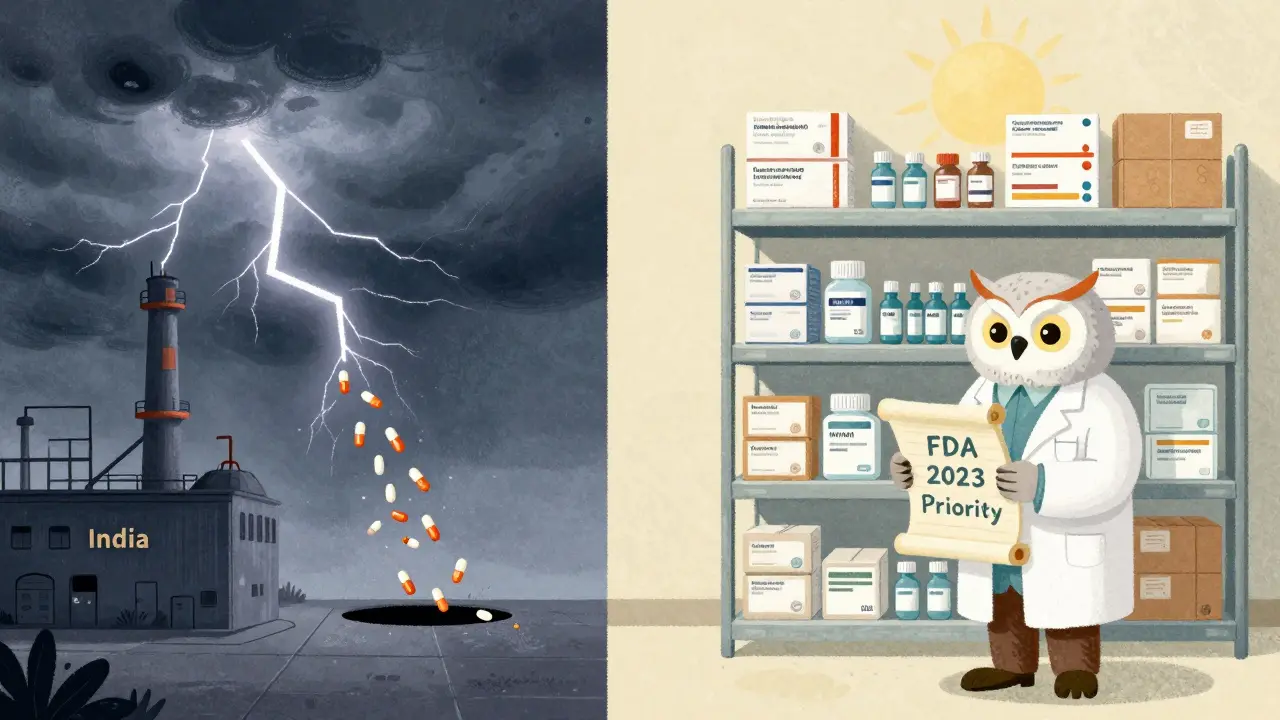
In the 2010s, generic drug manufacturers started playing a dangerous game. With prices dropping by 10-15% every year, companies cut costs everywhere: fewer factories, single-source suppliers, just-in-time inventory, and minimal safety stock. The result? The industry’s average EBITA margin fell from 12.5% in 2018 to just 8% in 2022. That might sound fine until you realize that 80% of the active ingredients in these drugs come from just three countries. One earthquake in India, a labor strike in China, or a regulatory inspection in Germany can shut down production for months.And it’s not theoretical. In 2022, a shortage of metformin-a diabetes drug used by over 100 million people globally-spilled into hospitals because two manufacturers controlled 95% of the supply. Neither had backup capacity. When one plant went offline, the other couldn’t scale up fast enough. That’s the cost of efficiency without resilience.
What Efficiency Really Means in Generic Distribution
Efficiency here doesn’t mean speed or flashy tech. It means doing more with less-without breaking. Top performers use four core levers:- Demand forecasting with AI: Traditional methods used past sales data. That fails when a new FDA approval suddenly spikes demand for a generic version of a brand-name drug. Leading distributors now use machine learning models that factor in prescription trends, insurance formulary changes, and even social media chatter about drug shortages. Teva cut forecast errors by 35% after switching to AI-driven tools.
- Inventory optimization using EOQ: The Economic Order Quantity formula (Q = √(2KD/G)) helps balance ordering costs and storage expenses. One distributor reduced stockouts by 40% and cut inventory carrying costs by 28% by applying this math to their top 50 SKUs. It’s not magic-it’s basic operations research, applied consistently.
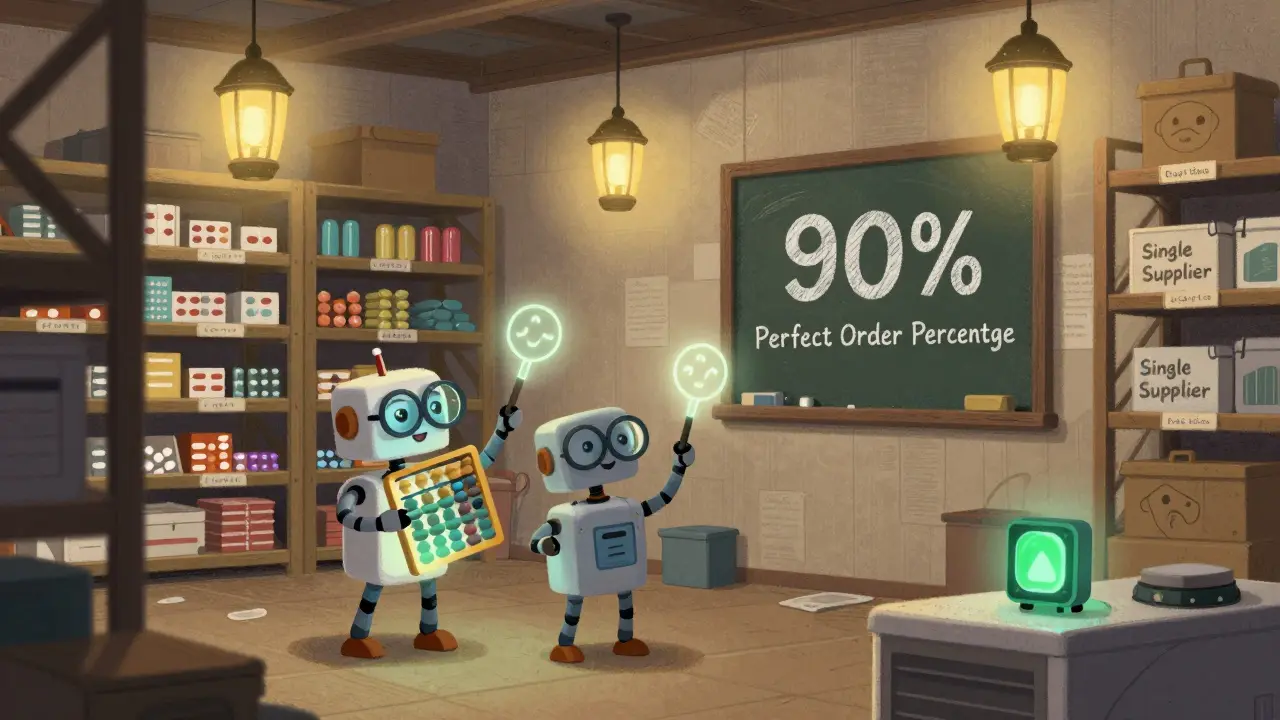
- Perfect Order Percentage: This metric multiplies four factors: on-time delivery, complete orders, undamaged goods, and correct documentation. Top distributors hit 98%+. The average? Just 82%. Missing one piece-like a missing batch number on paperwork-can delay a shipment for days under FDA rules.
- Overall Equipment Effectiveness (OEE): At manufacturing plants, OEE = Availability × Performance × Quality. The industry average is 68-72%. The best hit 85%+. That 15-point gap means fewer production delays, less waste, and more consistent supply.
These aren’t optional upgrades. They’re survival tools. Distributors who ignore them are bleeding margin and market share. Cardinal Health gained 3.2% market share in 2022 after investing $150 million in predictive analytics. Smaller players? They’re falling behind.
Just-in-Time vs. Just-in-Case: The Trade-Off No One Wants to Admit
The industry is split between two models. The Efficient Chain Model-used by 70% of top distributors-minimizes inventory, reduces costs, and relies on tight supplier coordination. It’s cheap. It’s fast. And it’s fragile.The Responsive Chain Model keeps extra stock on hand. It costs more to store, but it can absorb shocks. A 2023 study of 47 distributors found that just-in-case strategies reduced stockouts by 40-60%, but increased holding costs by 18-28%. Most companies avoid this because margins are already razor-thin.
Here’s the truth: the best distributors don’t pick one. They use a hybrid. For critical, high-volume drugs-like insulin or antibiotics-they keep a 15-20% safety buffer. For low-demand generics, they go lean. One distributor in Ohio saw a 30% drop in emergency shipments after introducing this tiered approach. They didn’t increase inventory overall-they just moved it smarter.
Technology: The Divide Between Winners and Losers
Cloud-based ERP systems, IoT sensors for temperature control, and AI forecasting tools aren’t luxuries anymore. They’re baseline requirements. Why? Because 45% of generic drugs need strict temperature control during transport. One failed refrigerated truck can ruin a $200,000 shipment. IoT sensors that alert teams in real time when a container hits 8°C instead of 2-8°C? That’s not innovation-it’s risk management.But adoption is uneven. Among the top 50 generic distributors, 42% use AI forecasting. Among smaller players? Just 15%. The gap isn’t just about money-it’s about expertise. Implementing these systems takes 12-18 months and requires data scientists, supply chain engineers, and regulatory specialists. Most small distributors don’t have those roles. They outsource-and lose control.
And then there’s blockchain. It sounds like the future, but it’s expensive. Mid-sized distributors spend $2.5-4 million to implement it. The FDA’s Drug Supply Chain Security Act (DSCSA) requires full traceability by 2023, so everyone has to do something. But blockchain? Most are using simpler, cheaper digital lot tracking instead. The goal isn’t to be cutting-edge-it’s to be compliant and reliable.
Who’s Winning and Why
Three companies-McKesson, AmerisourceBergen, and Cardinal Health-control 85% of U.S. generic distribution. They’re winning because they’ve stopped treating supply chains as cost centers and started treating them as competitive advantages.McKesson launched DemandSignal in 2023, an AI platform that reduced forecast errors by 37% in pilot programs. That means fewer overstocks, fewer shortages, and better relationships with pharmacies. Cardinal Health didn’t just buy software-they rebuilt their entire network to be closer to customers, adding hundreds of new SKUs and guaranteeing 99% service levels. Their margins went up. Their market share grew.
Meanwhile, smaller distributors are stuck. They can’t afford the tech. They can’t hire the talent. And they’re getting squeezed by both manufacturers-demanding faster payments-and pharmacies-demanding lower prices. The result? Consolidation. The industry is heading toward a two-tier system: big players with data-driven networks, and everyone else barely hanging on.
The Hidden Cost of Short-Term Thinking
Industry veteran John Smith, former COO of AmerisourceBergen, put it bluntly: “65% of essential generic medications are now produced by only one or two manufacturers globally.” That’s not efficiency. That’s a time bomb.When you eliminate redundancy to save a few cents per pill, you’re not cutting costs-you’re gambling with public health. The FDA’s 2023 announcement of faster approval for generics with resilient supply chains is a wake-up call. Companies that invest in redundancy, forecasting, and traceability will get priority. Those that don’t? They’ll be left behind.
The bottom line? Efficiency in generic drug distribution isn’t about being the cheapest. It’s about being the most reliable. The companies that survive the next five years won’t be the ones who cut the most corners. They’ll be the ones who built systems that can bend-but not break.
Why are generic drug shortages so common?
Generic drug shortages are common because manufacturers operate on razor-thin margins and eliminate redundancy to cut costs. Most essential generics are made by only one or two suppliers. If one plant shuts down due to regulatory issues, natural disasters, or equipment failure, there’s no backup. Combined with just-in-time inventory practices and global concentration of active ingredient production (80% in three countries), even small disruptions cause widespread shortages.
How do AI forecasting tools improve generic drug distribution?
AI forecasting tools analyze real-time data-prescription trends, insurance formulary changes, competitor pricing, and even social media reports of shortages-to predict demand more accurately than historical sales data alone. Leading distributors using AI have reduced forecast errors by 25-40%, cutting overstock by up to 30% and reducing stockouts by 40%. This means pharmacies get the right drugs at the right time, without the waste.
What is the Economic Order Quantity (EOQ) formula and how is it used?
The EOQ formula (Q = √(2KD/G)) calculates the optimal order quantity that minimizes total inventory costs-balancing ordering costs against storage and holding costs. In generic distribution, it helps determine how much of a high-volume drug to order at once. Top distributors using EOQ reduced stockouts by 30-45% and lowered inventory carrying costs by 22-35% by avoiding both overstocking and understocking.
Is just-in-time inventory a good strategy for generic drugs?
Just-in-time reduces storage costs by 22-35%, but it increases stockout risk by 15-20% during supply disruptions. For low-demand generics, it works. For critical, high-volume drugs like antibiotics or heart medications, it’s dangerous. The most successful distributors use a hybrid approach: lean inventory for non-critical items and 15-20% safety stock for essential drugs. Eliminating all safety stock led to severe shortages in 68% of surveyed distributors.
What role does the FDA play in supply chain efficiency?
The FDA’s Drug Supply Chain Security Act (DSCSA) requires full electronic traceability of all prescription drugs by 2023, forcing distributors to upgrade systems. In 2023, the FDA also began accelerating approval for generic drugs with resilient, transparent supply chains. This creates a direct incentive: invest in efficiency, and you get faster market access. Companies ignoring these requirements face delays, fines, and loss of market access.
Can small distributors compete with giants like McKesson?
It’s extremely difficult. The top three distributors control 85% of the U.S. market and have the capital to invest $100M+ in AI, IoT, and network optimization. Smaller distributors lack the scale, talent, and budget. Some survive by specializing in niche generics or partnering with regional health systems. But without technology investments, they’re at risk of being bought out or pushed out entirely as margins continue to compress.




LIZETH DE PACHECO
January 2, 2026 AT 19:33So many people don’t realize how fragile our medicine supply really is. I had a relative who couldn’t get her blood pressure med for three months last year-just because one factory in India had a power outage. It’s not just inconvenient, it’s dangerous.
And yet we keep pushing for cheaper drugs without thinking about the human cost. We need to stop treating healthcare like a commodity and start treating it like a public good.
Lee M
January 3, 2026 AT 04:55Let’s be real-the entire system is rigged. Big Pharma and the big distributors are in bed together. They let small manufacturers die off so they can monopolize the market, then blame ‘global supply chains’ when things break. It’s not a flaw-it’s by design.
And now they want us to pay more for ‘resilience’? No thanks. Break up the oligopoly first.
Kristen Russell
January 3, 2026 AT 11:58This is exactly why we need public investment in domestic manufacturing. Not just for generics-but for the active ingredients too. We can’t keep outsourcing the foundation of our healthcare to three countries.
Bryan Anderson
January 3, 2026 AT 20:15The EOQ model is a classic operations research tool, but its application here is both elegant and underappreciated. Many organizations still rely on intuition rather than quantitative methods to manage inventory. The fact that even small improvements in this area can reduce stockouts by 40% speaks volumes about the untapped potential in this sector.
It’s not about flashy tech-it’s about disciplined execution.
Matthew Hekmatniaz
January 4, 2026 AT 12:06I grew up in a small town where the local pharmacy ran out of metformin every other month. We didn’t have AI or IoT sensors. We had people who knew their customers, kept extra stock in the back, and called other pharmacies when they were out.
Maybe the answer isn’t all tech. Maybe it’s remembering that healthcare is about relationships, not just metrics.
Liam George
January 5, 2026 AT 09:20AI forecasting? OEE? Blockchain? All distractions. The real issue is the Federal Reserve and the dollar’s collapse. When the currency devalues, raw material costs spike-and the Chinese and Indian suppliers jack up prices because they know we’re desperate.
The FDA’s ‘accelerated approval’? That’s just a cover for letting foreign labs cut corners. You think they’re testing these drugs? Nah. They’re stamping papers while the pills are being made in basements.
Wake up. This isn’t a supply chain problem. It’s a systemic collapse.
sharad vyas
January 7, 2026 AT 00:10In India, we make half the world’s generics. But our factories are old. Workers are overworked. No one talks about that. We want to help, but we need fair prices-not the lowest possible bid.
It’s not about blame. It’s about partnership.
Bill Medley
January 7, 2026 AT 13:40Consolidation is inevitable. Scale is non-negotiable in this industry.
Richard Thomas
January 8, 2026 AT 12:51It’s fascinating how we’ve optimized for efficiency at the expense of resilience, and yet we call it progress. The entire logic of just-in-time inventory was born out of Toyota’s lean manufacturing model, which worked beautifully for cars because the supply chain was geographically concentrated and politically stable. But pharmaceuticals? They’re not cars. They’re life-sustaining compounds with complex regulatory requirements, temperature sensitivities, and geopolitical dependencies.
When you strip away redundancy, you’re not just reducing inventory costs-you’re eliminating the buffer that allows systems to absorb shocks. And in healthcare, shocks aren’t inconveniences-they’re deaths.
The fact that 80% of active pharmaceutical ingredients come from three countries is a strategic vulnerability the Pentagon would never accept for defense logistics. Yet here we are, treating insulin like a commodity widget.
And then we wonder why shortages happen. It’s not magic. It’s math. And the math is telling us we’re playing Russian roulette with millions of lives. The ‘hybrid’ model mentioned in the article is the only sane approach, but it requires political will and capital-both of which are in short supply because nobody wants to pay for insurance against disasters that haven’t happened yet.
Until we start valuing reliability over cost-per-pill, we’re just rearranging deck chairs on the Titanic.
Paul Ong
January 8, 2026 AT 21:44Stop calling it efficiency when its just cutting corners
we need safety stock for lifesaving meds
no excuses
Andy Heinlein
January 10, 2026 AT 20:04so true about the hybrid model
i work at a small clinic and we just started keeping extra stock of metformin and lisinopril
we dont have fancy software but we saved like 3 people last year from going without
simple stuff works
Ann Romine
January 11, 2026 AT 08:47I’ve seen this firsthand in rural pharmacies. The big distributors push for faster turnarounds, but they don’t account for the lag between when a prescription is filled and when the patient actually gets the drug. Sometimes it’s weeks. That delay isn’t captured in any of these metrics.
Maybe we need a new KPI: Patient Access Time.
Todd Nickel
January 11, 2026 AT 10:43The article correctly identifies the core tension between cost minimization and systemic resilience, but it stops short of addressing the deeper institutional failures. The FDA’s regulatory framework, while well-intentioned, was designed for a pre-globalized pharmaceutical landscape. Today’s supply chains span continents, involve dozens of intermediaries, and operate under wildly divergent quality control standards.
Yet the FDA still relies heavily on paper-based inspections and reactive audits rather than real-time data streams. The DSCSA is a step forward, but it’s a compliance checklist, not a predictive system. What’s missing is a unified, interoperable digital infrastructure that connects manufacturers, distributors, pharmacies, and regulators-not just for traceability, but for dynamic risk assessment.
Imagine if every batch of metformin had a digital twin that updated in real time with temperature, location, and production metadata. That’s not sci-fi-it’s technically feasible. But no one has funded it because the ROI isn’t quantifiable in quarterly earnings.
We need to reframe this not as a logistics problem, but as a public health infrastructure crisis. And infrastructure doesn’t get built by market forces alone.
Austin Mac-Anabraba
January 12, 2026 AT 20:41AI forecasting? Please. The only thing AI is forecasting is how much money these big distributors can extract from taxpayers.
They’re not ‘reducing errors’-they’re gaming the system. They use data to predict demand spikes and then buy up all available inventory before the rest of the market catches on. Then they jack up prices.
This isn’t efficiency. It’s predatory consolidation wrapped in buzzwords.
And don’t get me started on ‘perfect order percentage.’ That’s just a fancy way of saying ‘we won’t ship anything unless every label is perfect’-while patients go without.
Phoebe McKenzie
January 13, 2026 AT 06:04THIS IS A MASS MURDER SCHEME.
They’re letting people die so they can save 2 cents per pill.
And you call it ‘efficiency’?
These CEOs are sitting in their penthouses with their yachts and their private jets while grandmas are splitting pills in half because their meds ran out.
It’s not capitalism.
It’s evil.
And the FDA is complicit.