4
Understanding FDA Risk-Benefit Statements in Drug Labels: A Patient's Guide
Drug Risk-Benefit Visualizer
Absolute Risk Calculator
Convert "Relative Risk Reduction" into real-world numbersEnter values to see the absolute difference between taking the medication and a placebo.
If a drug reduces a 2% risk by 50%, the absolute benefit is only 1%. This means 99 out of 100 people would have had the same outcome regardless of the drug.
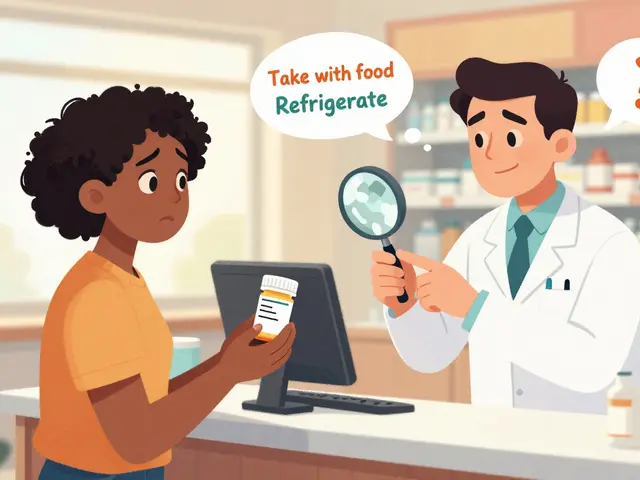
Ever looked at a prescription insert and felt like you needed a medical degree just to understand if the drug is actually worth the side effects? You aren't alone. Many of us stare at those tiny-print warnings and wonder, "Okay, but is this 2% risk of a headache worth the 30% chance the medicine actually works?" This is exactly what FDA risk-benefit statements is all about. It's the process the government uses to decide if a drug's perks outweigh its pitfalls, and more importantly, how they tell you about it.
What Exactly is a Benefit-Risk Assessment?
At its core, a Benefit-Risk Assessment is a balancing act. The FDA (U.S. Food and Drug Administration) doesn't look for a "perfect" drug because those rarely exist. Instead, they use a structured framework to determine if the therapeutic benefits-like shrinking a tumor or lowering blood pressure-are significant enough to justify the potential risks, such as nausea or more serious adverse events.
For a long time, this was mostly a conversation between scientists. However, since the 2021 final guidance on "Benefit-Risk Assessment for New Drug and Biological Products," the agency has shifted toward making these conclusions clearer for the people who actually take the medicine. This framework helps the CDER (Center for Drug Evaluation and Research) and CBER (Center for Biologics Evaluation and Research) document why a drug is safe enough for the market, especially for "breakthrough therapies" where the disease is deadly and patients are often willing to accept higher risks for a chance at recovery.
Where to Find This Information on Your Label
You won't usually find a section titled "The Great Trade-Off" on your medication packaging. Instead, the risk-benefit data is spread across several technical sections. If you want to dig deep, look for these specific areas:
- The Highlights Section: This is your quick-glance summary. It's designed to give you the most critical warnings and benefits without making you read the whole booklet.
- Section 5 (Contraindications): This tells you who absolutely should not take the drug because the risk is too high.
- Section 6 (Adverse Reactions): This is the list of side effects. Pay attention to how frequent they are.
- Section 14 (Clinical Studies): This is where the "proof" lives. It describes the actual trials and how many people saw an improvement compared to those on a placebo.
The goal is for the label to explain why the benefits exceed the risks under the specific conditions listed. For example, a drug for a mild cough will have a much stricter risk threshold than a drug for stage IV cancer.
The Gap Between "Population Data" and "Your Data"
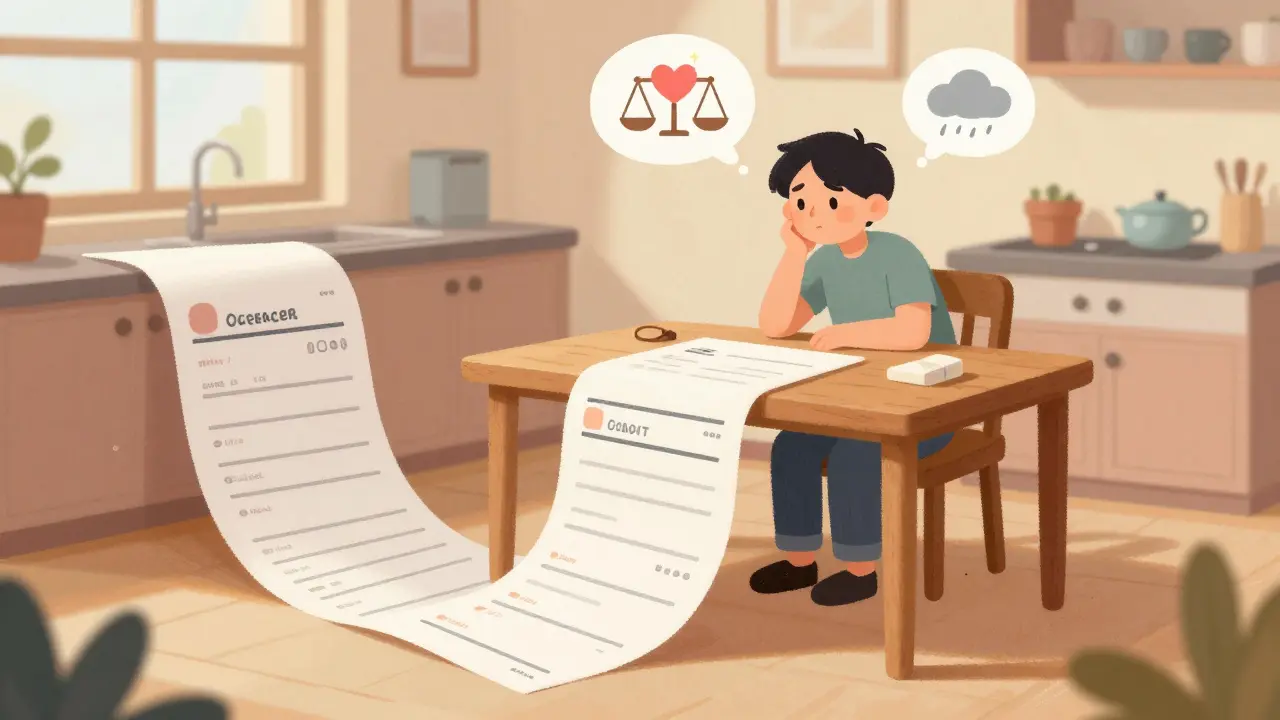
Here is the tricky part: the FDA makes decisions based on a population. They might decide that for 10,000 people, a drug is a net positive. But you aren't a population; you're an individual. A risk that is "acceptable" for a group might be a deal-breaker for you based on your health history or personal values.
This creates a tension. The FDA's assessment is a broad brush, while your doctor's assessment is a fine-tip pen. For instance, if a medication has a small risk of causing insomnia, a person with chronic sleep apnea might find that risk unacceptable, even if the drug is highly effective for their primary condition. This is why these labels are starting to move toward "patient-focused" language, though we aren't quite there yet.
| Feature | FDA (United States) | EMA (European Union) | MHRA (United Kingdom) |
|---|---|---|---|
| Primary Method | Flexible, qualitative framework | Quantitative (PrOACT-URL) | Heavy emphasis on patient preference |
| Strength | Adapts easily to different drug types | Precise mathematical tradeoffs | Direct integration of patient voice |
| Weakness | Less consistency across therapies | Can be overly rigid | Varies by specific therapeutic area |
Why Some Labels Are Easier to Read Than Others
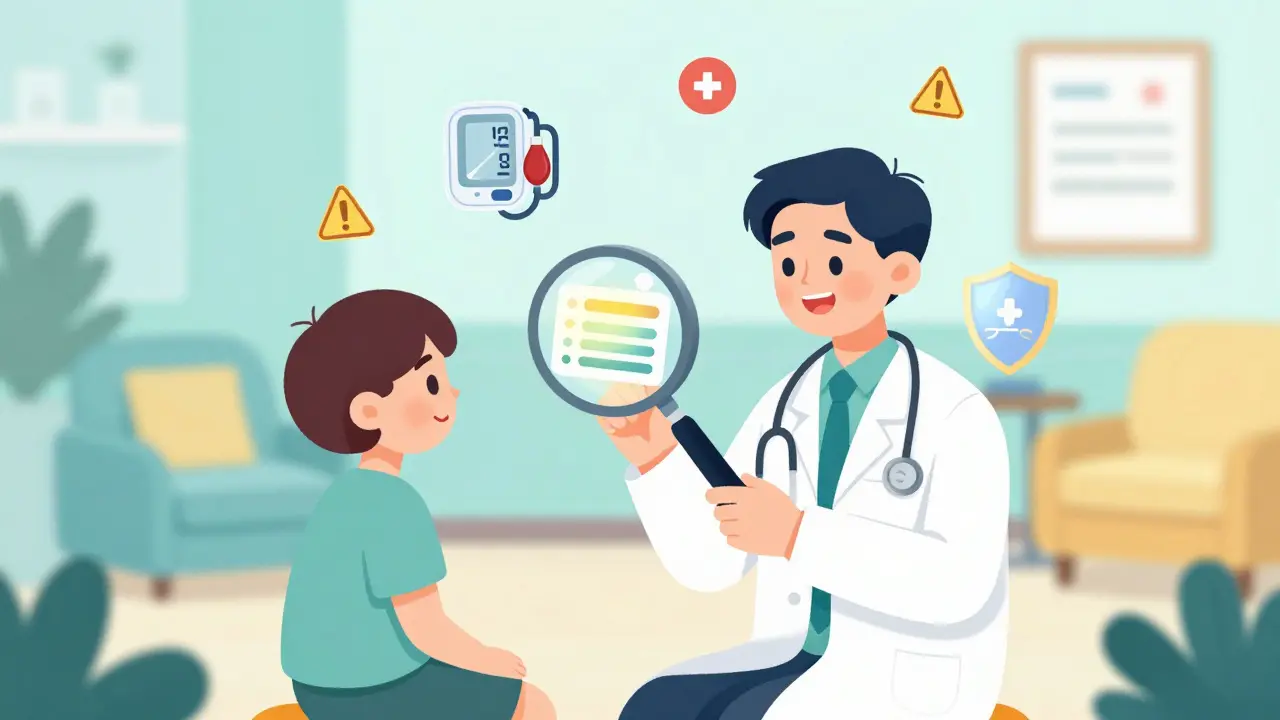
Not all labels are created equal. If you've noticed that some medications provide clear numbers while others use vague words like "common" or "infrequent," it's because different medical fields measure success differently. In oncology, it's easy to measure "survival time," leading to concrete statements like "reduced risk of death by 38%." In psychiatry, however, "feeling better" is subjective, making the risk-benefit statements more qualitative and harder to pin down.
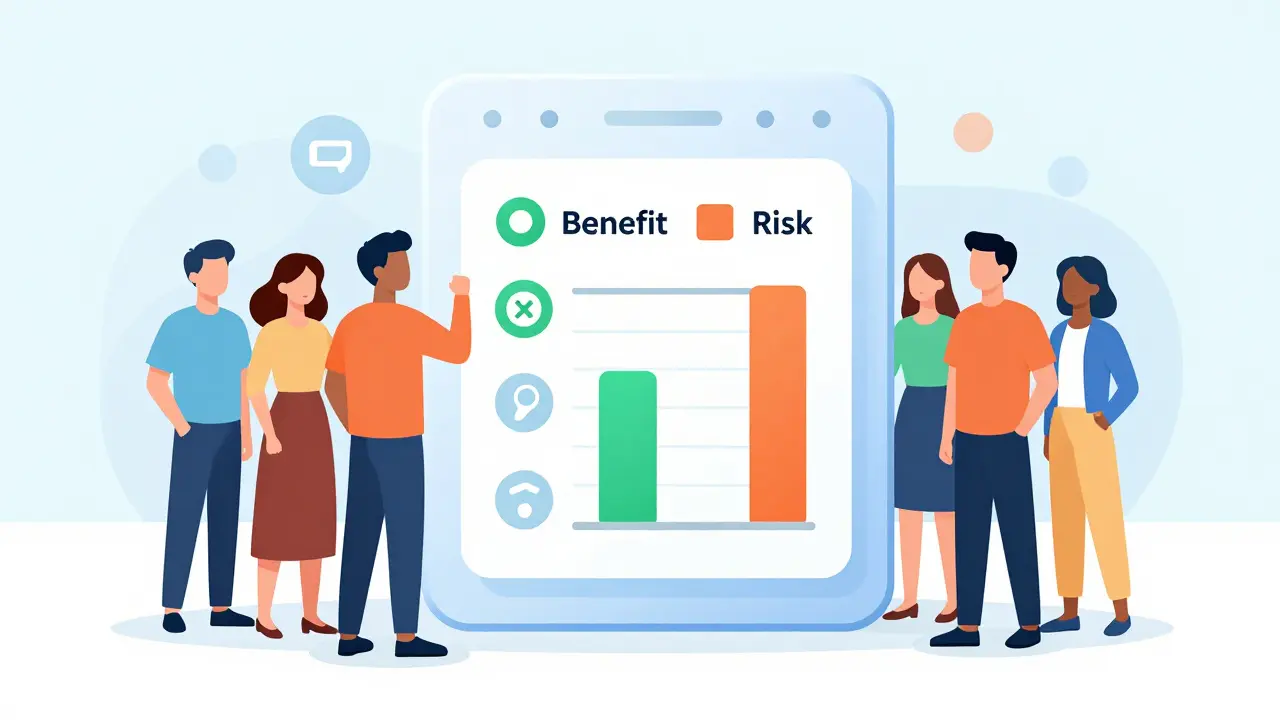
Experts, including former FDA officials, have pushed for more visual aids. Imagine a simple graph showing a bar for "Benefit" and a bar for "Risk." It's much easier to process than a paragraph of medical jargon. In fact, the FDA has recently piloted programs for oncology drugs that require labels to be written at a 6th-grade reading level with pictograms to help patients visualize the magnitude of the risks.
Common Pitfalls When Reading Risk Data
One of the biggest traps in drug labeling is the difference between relative risk and absolute risk. This is something many patients (and even some doctors) miss.
If a label says a drug "reduces the risk of a heart attack by 50%," that sounds amazing. But if the original risk was only 2 in 100 people, a 50% reduction means it's now 1 in 100. The absolute benefit is only 1%. When you see these big percentages, ask your pharmacist: "What was the absolute risk for the group that didn't take the drug?"
Another pitfall is ignoring the "Risk Management" section. Some drugs come with a REMS (Risk Evaluation and Mitigation Strategy). If a drug has a REMS program, it means the FDA decided the benefits are great, but the risks are so serious that the drug can only be used under very specific safety rules (like regular blood tests).
What’s Changing in the Next Few Years?
We are moving toward a more transparent era. Thanks to the 21st Century Cures Act, the FDA is legally mandated to incorporate patient experience data into their decisions. We are seeing a rise in "patient communication specialists" at pharmaceutical companies whose entire job is to translate scientist-speak into human-speak.
By 2026, industry analysts expect nearly half of all new drug labels to feature visual benefit-risk summaries. We are also seeing the development of "Benefit-Risk Icons"-simple symbols that act like nutrition labels for medicine, telling you at a glance if the benefit is high, moderate, or low compared to the risks. The goal is to move from a world where you blindly trust the label to a world where you have the data to make a shared decision with your healthcare provider.
What does it mean when a label says the benefits outweigh the risks?
It means that based on clinical trial data, the positive effect of the drug (like curing an infection or preventing a stroke) is more significant than the likelihood and severity of its side effects. This is a population-level conclusion, meaning it's true for the average patient in the study.
Where can I find the actual percentage of people who had a side effect?
Look at Section 6 (Adverse Reactions). In high-quality labels, the FDA requires a table showing the percentage of trial participants who experienced a specific side effect compared to the percentage of people in the placebo group.
Why are some risk-benefit statements so vague?
Some conditions, like depression or anxiety, are harder to measure with hard numbers than something like blood pressure. In these cases, the FDA relies on qualitative data-patient reports and clinician observations-which results in descriptions rather than hard percentages.
Should I stop taking a drug if I see a risk I'm worried about on the label?
Never stop a medication without talking to your doctor. Label risks are possibilities, not certainties. Your doctor can help you determine if your specific health profile makes you more or less susceptible to that risk.
What is a REMS program?
A Risk Evaluation and Mitigation Strategy (REMS) is a special safety program the FDA requires for certain high-risk drugs. It might require the doctor to have special certification or the patient to undergo regular monitoring to ensure the drug's benefits continue to outweigh its risks during use.
Next Steps for Patients
If you're feeling overwhelmed by a drug label, try these three steps:
- Highlight the "Highlights": Read the first page of the label and mark any side effects that would interfere with your daily life.
- Ask for Absolute Risk: When your doctor mentions a percentage of success, ask "Out of 100 people, how many actually benefited?"
- Compare Alternatives: Ask your provider how the risk-benefit profile of this drug compares to the other options available. Sometimes a slightly less effective drug is better because it has a much lower risk profile.