29
How to Carry Injectables, Syringes, and Sharps on Airplanes: A Clear Guide for Travelers

Traveling with injectable medications like insulin, EpiPens, or hormone therapies doesn’t have to be stressful-if you know the rules. Every year, millions of people fly with medical supplies they need to stay healthy. But too many travelers get stopped at security, face delays, or even risk having their meds confiscated because they didn’t prepare properly. The good news? You’re legally allowed to bring injectables, syringes, and sharps on planes in the U.S. and most international destinations. The trick is knowing how to do it right.
What You Can Bring on a Plane
You can bring as much medication as you need, no matter how many vials or syringes. The TSA doesn’t limit the quantity of injectables for medical use. That includes insulin, glucagon, testosterone, anticoagulants, and other life-sustaining injections. Unused syringes? No cap. Used syringes? Also allowed-but only if they’re stored safely.
Liquid medications can exceed the 3.4-ounce (100ml) limit that applies to regular toiletries. But here’s the catch: you must declare them at the security checkpoint. Don’t wait for an officer to ask. Say it upfront: “I have medically necessary liquids.” This cuts down on confusion and delays.
Ice packs and gel packs for keeping meds cool? Permitted without size limits. But they’ll likely need to be screened separately. Remove them from your bag and place them in a bin. If they’re frozen solid, that’s fine. If they’re melting, TSA may ask for proof they’re for medical use-so keep your meds in original packaging.
How to Pack Syringes and Sharps
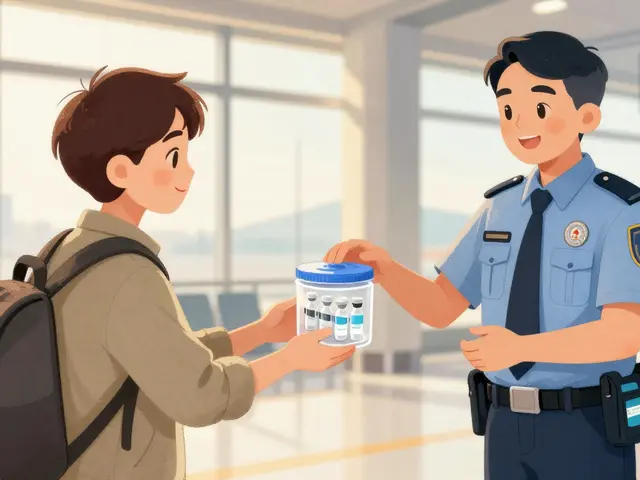
Never throw used syringes into your regular luggage or purse. That’s a safety hazard-and a violation of federal guidelines. Used sharps must go in an FDA-approved sharps container. These are rigid, puncture-resistant, and labeled with the universal biohazard symbol.
Look for containers that meet ANSI/ISEA Z308.1-2021 or IATA Packing Instruction 650 standards. Many pharmacies sell travel-sized sharps containers (under $10). Some even come with pre-paid return labels for disposal after your trip.
If you don’t have one, a sturdy plastic bottle with a tight lid (like a laundry detergent bottle) works as a temporary solution-but only if it’s labeled and sealed. TSA officers may still allow it, but they’re more likely to approve a proper container. A 2023 survey found that 82% of travelers who used approved sharps containers passed through security without issue. Only 47% did when using improvised containers.
Documentation: Do You Need a Doctor’s Note?
TSA doesn’t require a doctor’s note to carry injectables. But having one can save you hours of hassle. A simple note on letterhead saying “Patient requires daily insulin injections” is enough. Include your name, medication name, dosage, and the doctor’s contact info.
Even better? Keep all medications in their original pharmacy-labeled containers. The label should match the name on your ID. If your insulin vial says “John Smith” but your passport says “Jane Smith,” you’ll get questions. Pharmacies can re-label prescriptions for travel if needed.
Many travelers use the TSA Notification Card (Form TSA-11-032). It’s a small card you can print from tsa.gov. Hand it to the officer before you reach the checkpoint. It says exactly what you’re carrying and why. Since its rollout, miscommunication at checkpoints dropped by 29%.

What Happens at Security
When you get to the checkpoint, tell the officer: “I have medical equipment.” Then hand them your medications, syringes, and sharps container separately. Don’t hide them in your toiletries bag. Keep them visible.
Expect your items to be screened. That might mean a swab test, a visual inspection, or even a manual search. Don’t get upset if they ask to open your sharps container. They’re trained to handle this. But if you’re nervous, ask for a private screening. You have the right to it.
For temperature-sensitive meds like insulin, request a visual inspection instead of an X-ray. While X-rays won’t damage most medications, some people prefer to avoid them. TSA agents are required to accommodate this request.
Pro tip: If you’re in TSA PreCheck, you’re more likely to get faster screening. PreCheck lanes have fewer delays for medical items. One airline’s internal report showed medical screening time dropped by 50% in PreCheck lanes.
International Travel: Rules Vary
Domestic U.S. flights follow TSA rules. But if you’re flying internationally, you’re subject to the destination country’s laws. This is where things get tricky.
For example: Japan requires a special permit for any syringe carrying more than 10 units of medication. Australia requires a letter from your doctor in English. The UK allows syringes but only if they’re in original packaging with a prescription label.
Always check your destination’s health authority website 30-60 days before you fly. The World Health Organization’s Air Travel Medical Task Force is working on global standards, but they’re not in place yet. Don’t assume U.S. rules apply abroad.
Some countries require medications to be declared on arrival forms. Others may confiscate unmarked vials. A traveler in Dubai once had their insulin seized because the vial didn’t have an English label. They got it back after 12 hours-but missed their connecting flight.
What Not to Do
Don’t tape syringes to your body. It looks suspicious and can trigger alarms.
Don’t carry syringes without medication. TSA says this is the #1 cause of delays. Officers can’t tell if a syringe is for insulin or something else. Always keep the medication with the syringe.
Don’t pack sharps in checked luggage. If your bag gets lost, you lose your meds. And if someone finds them, it’s a safety risk. Always carry sharps in your carry-on.
Don’t rely on airport pharmacies. Not all airports stock insulin or other injectables. Even if they do, prices are high and availability isn’t guaranteed.

Real Traveler Tips
One diabetic traveler on Reddit said she keeps her insulin in a small insulated pouch with a cold pack. She labels it with her name and “Medication - Do Not X-Ray.” She’s never been denied boarding.
Another user carries a printed copy of the TSA medical guidelines in his wallet. When an officer looks confused, he hands it over. “It’s like a cheat sheet,” he says. “They appreciate it.”
For long flights, bring extra meds. Pack at least a 3-day supply in case your luggage is delayed. Keep half in your carry-on, half in your pocket. And always carry a backup EpiPen or glucagon kit if you’re at risk for an emergency.
What If You’re Denied?
If an officer refuses your meds, ask to speak to a supervisor. Most of the time, the issue is misunderstanding-not policy. TSA agents are trained on medical rules, but not all have had updated training. A 2023 Johns Hopkins study found that 42% of passengers with diabetes faced delays due to inconsistent officer knowledge.
If you’re still stuck, call TSA Cares at 1-855-787-2227. It’s a helpline for travelers with disabilities or medical needs. They can send a specialist to help you at the checkpoint. You need to call at least 72 hours before your flight.
Remember: The Air Carrier Access Act protects you from discrimination. If you’re denied boarding because of your meds, file a complaint with the Department of Transportation. You’re not breaking the law-you’re exercising your right to medical care.
Final Checklist Before You Fly
- ✔ All injectables in original pharmacy containers with your name on the label
- ✔ Unused syringes stored with their matching medication
- ✔ Used syringes in an FDA-approved sharps container
- ✔ Ice packs or gel packs declared at security
- ✔ TSA Notification Card printed and ready
- ✔ Doctor’s note (recommended, not required)
- ✔ Extra meds for delays or lost luggage
- ✔ Destination country’s rules checked and followed
Traveling with medical equipment isn’t about bending rules-it’s about knowing them. With the right prep, you’ll breeze through security and focus on your trip, not your meds. Millions do it every year. You can too.
Can I bring insulin on a plane without a prescription?
Yes. You don’t need a prescription to carry insulin or other injectables on a U.S. flight. But you must have the medication with you and keep it in its original labeled container. TSA doesn’t require a prescription, but having one helps avoid confusion.
Can I put syringes in my checked luggage?
No. Syringes and sharps must be carried in your carry-on bag. Checked luggage can be mishandled, lost, or opened by baggage handlers who aren’t trained to handle medical sharps. Keeping them with you ensures safety and compliance.
Do I need to declare my insulin at security?
Yes. Even though insulin is exempt from the 3.4-ounce liquid rule, you must tell the TSA officer you have medically necessary liquids. Declare them before you reach the X-ray machine. This prevents delays and ensures proper screening.
Can I bring a needle without medication on a plane?
No. TSA prohibits carrying syringes or needles without the corresponding medication. Officers cannot determine the purpose of an empty syringe, and it raises security concerns. Always keep your syringes with the medication they’re meant to use.
Are sharps containers allowed on international flights?
Yes, as long as they meet IATA standards and are declared. But rules vary by country. Some nations require permits for syringes, while others demand English-language labels. Always check your destination’s health regulations before flying.



Kunal Karakoti
December 30, 2025 AT 13:38It's wild how something so basic-like carrying insulin-still requires a PhD in bureaucracy to navigate. We treat medical necessity like a privilege, not a right. The fact that you need a printed card, a doctor’s note, and a sharps container that meets ANSI standards just to stay alive while flying says more about our systems than it does about travelers. We’ve turned survival into a compliance exercise.
Joseph Corry
January 1, 2026 AT 10:29Let’s be real-this guide is just TSA’s PR department with a thesaurus. The real issue isn’t the rules, it’s the inconsistent enforcement. I’ve had officers who knew exactly what to do and others who treated my EpiPen like a potential IED. This isn’t about preparation-it’s about institutional incompetence masked as policy. And don’t get me started on the ‘TSA Notification Card.’ It’s a Band-Aid on a hemorrhage.
srishti Jain
January 2, 2026 AT 05:16Cheyenne Sims
January 3, 2026 AT 06:14The assertion that TSA does not require a doctor’s note is factually correct, yet profoundly irresponsible. While the letter of the law may not mandate documentation, the absence of clinical verification invites systemic abuse. One must consider the precedent: if unverified injectables are permitted without corroborating evidence, what prevents the normalization of unregulated pharmaceutical transport? This is not a matter of convenience-it is a matter of public safety.
Shae Chapman
January 4, 2026 AT 16:29OMG YES this is so important!! 💕 I carry my insulin in this cute little cooler pouch and I always say ‘medically necessary’ at security and they’re always so nice 😭 I’ve never had an issue but I cried the first time they let me through without a fuss. Please, please, please bring your meds with you!! 🙏✈️💉
Nadia Spira
January 6, 2026 AT 11:07Look, this guide reads like a corporate compliance pamphlet written by someone who’s never actually had to carry insulin on a flight. The ‘TSA Notification Card’? A performative gesture. The ‘FDA-approved sharps container’? A $12 scam. The real solution? Decriminalize medical autonomy. Stop treating people with chronic conditions like potential threats. This isn’t about ‘rules’-it’s about power. And the system wins every time you jump through hoops to stay alive.
henry mateo
January 6, 2026 AT 13:24just wanted to say i had a really rough time last year with my glucagon kit and the agent didnt know what it was and i was so scared. i ended up showing them the bottle and they said 'oh thats for diabetes?' and just waved me through. i wish i had known about the notification card before. also, i accidentally left my sharps container in my checked bag once and it got lost. never again. always carry it.
Kelly Gerrard
January 7, 2026 AT 21:52While the intent of this guide is commendable, it fundamentally fails to address the structural inequities embedded in the current system. The burden of compliance falls disproportionately on marginalized populations who lack access to labeled prescriptions, travel-sized containers, or the time to research international regulations. This is not empowerment-it is surveillance disguised as assistance.
Glendon Cone
January 8, 2026 AT 14:43Big thanks for this. I’ve been flying with insulin for 8 years and this is the first time I’ve seen a guide that actually gets it. I use the TSA card and always put my meds in a clear bag with my name on it. One time an officer asked if I was diabetic and I just said ‘yes’ and handed him the bottle. He nodded and said ‘you’re good.’ No drama. Keep it simple. Also, if you’re on a long flight, bring snacks. Low blood sugar doesn’t care about your itinerary. 🙌💉
Henry Ward
January 9, 2026 AT 08:19People who bring syringes on planes are either responsible adults or reckless idiots. There’s no middle ground. If you can’t be bothered to buy a $10 sharps container or print a one-page note from your doctor, then you’re not deserving of the privilege to fly. This isn’t about discrimination-it’s about responsibility. And if you think the TSA is being harsh, you clearly haven’t seen what happens when someone tries to sneak in needles without meds. Don’t be that person.