12
Low-GI Diet for Weight Control: What Actually Works
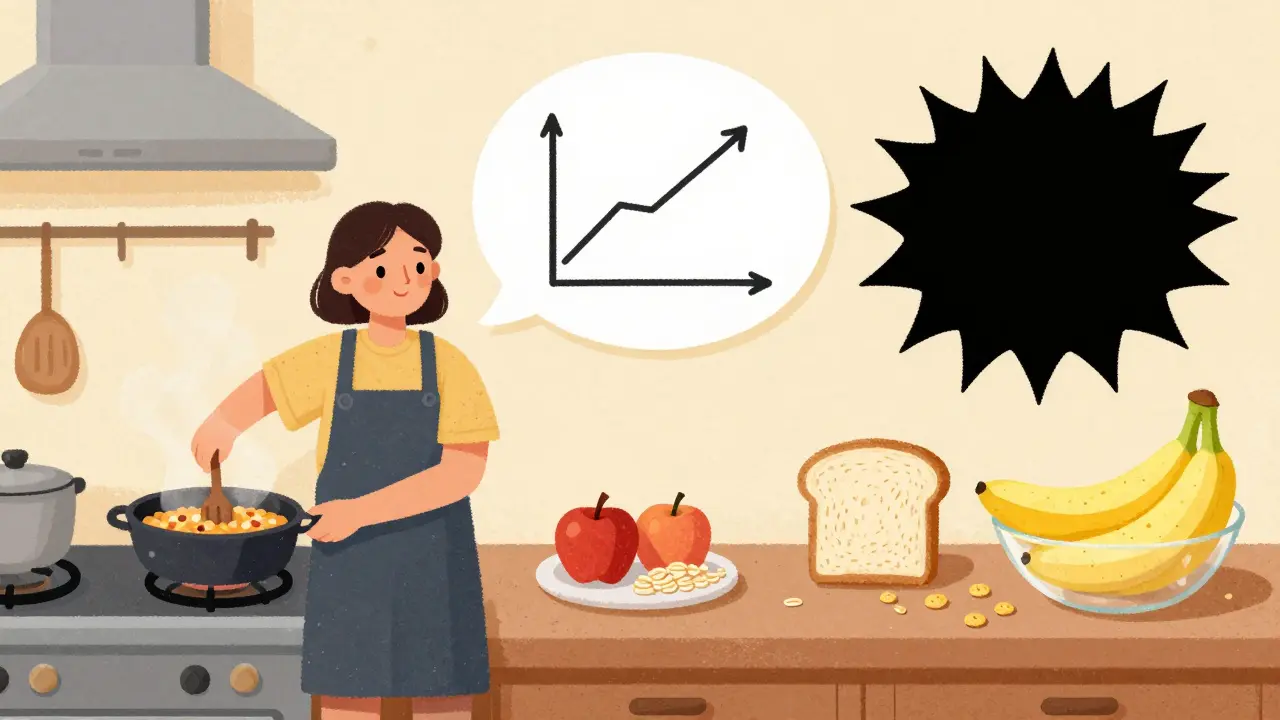
When you hear low-GI diet, you might think it’s the secret to losing weight without counting calories. But here’s the truth: it’s not that simple. The glycemic index (GI) measures how quickly a food turns into sugar in your blood. Foods with a low GI-like lentils, oats, and apples-raise blood sugar slowly. High-GI foods-like white bread, potatoes, and cornflakes-cause sharp spikes. The idea behind the low-GI diet is that steady blood sugar means less insulin, less hunger, and less fat storage. Sounds perfect, right? But does it actually help you lose weight? Let’s break it down.
What Is the Glycemic Index, Really?
The glycemic index was created in 1981 by Dr. David Jenkins and his team at the University of Toronto. They ranked foods from 0 to 100 based on how much they raised blood sugar after eating, with pure glucose as the baseline (GI = 100). Today, we use three categories:
- Low-GI: 55 or less - Think beans, most fruits, non-starchy veggies, barley, and oats.
- Medium-GI: 56-69 - Think brown rice, sweet potatoes, and whole wheat bread.
- High-GI: 70 or higher - Think white bread (GI=75), instant rice (GI=73), and cornflakes (GI=81).
It’s not just about the food itself. Cooking matters. Al dente pasta has a GI of 45; overcooked pasta jumps to 65. An unripe banana is GI 30; a ripe one is GI 51. Even the order you eat food in can change the result-eating protein or fat before carbs slows absorption.
But here’s the catch: your body’s response to a food can be totally different from someone else’s. A 2015 study from the Weizmann Institute found that two people eating the same banana could have blood sugar spikes that differed by 20 points. That’s why rigid GI lists can be misleading.
Does Low-GI Help You Lose Weight?
This is where things get messy. Many people believe low-GI foods make you feel fuller longer, so you eat less. That’s partly true. Fiber-rich, slow-digesting carbs do help with satiety. But when researchers control for calories, the advantage disappears.
A 2022 analysis by the American Institute for Cancer Research looked at 12 randomized trials with over 1,300 participants. All diets had the same number of calories. The low-GI group didn’t lose more weight than the high-GI group. Same for the 2018 DIETFITS trial, which tracked 600 people for a year. Both low-GI and high-GI dieters lost around 6.5 kg-no difference.
So why do some people swear by it? Because low-GI diets often mean eating more whole foods-beans, veggies, nuts, whole grains-and fewer processed snacks. That’s not because of the GI number. It’s because those foods are naturally more filling and less calorie-dense.
Dr. David Ludwig from Harvard says low-GI diets may boost metabolism slightly-by 50 to 100 calories a day-by lowering insulin. But Karen Collins from the same institute counters: “When calories are equal, GI doesn’t move the needle on weight loss.”
Where Low-GI Actually Shines
If weight loss isn’t the clear win, what is? Blood sugar control. For people with type 2 diabetes or prediabetes, low-GI diets are one of the most proven tools.
A 2019 review of 54 studies showed that low-GI diets lowered HbA1c (a measure of long-term blood sugar) by 0.5% on average-compared to just 0.2% with high-GI diets. That’s not huge, but it’s meaningful. It means fewer insulin spikes, less strain on the pancreas, and lower risk of complications.
Studies also show low-GI diets improve cholesterol. LDL (bad cholesterol) dropped by 4.7 mg/dL on average in trials reviewed by the Academy of Nutrition and Dietetics. That’s similar to the effect of small statin doses. The European Association for the Study of Diabetes gives low-GI diets a Grade A recommendation for diabetes management.
And it’s not just about diabetes. People with metabolic syndrome-high blood pressure, belly fat, insulin resistance-see better outcomes when they swap out high-GI carbs for low-GI ones. The World Health Organization now includes low-GI carbohydrates in its 2023 diabetes prevention guidelines, citing a 15-20% drop in new cases over time.
What Foods Actually Belong on a Low-GI Plate?
Don’t fall for the trap of thinking “low-GI = healthy.” Chocolate cake has a GI of 38. Ice cream? 37. Both are low-GI, but neither should be your go-to snack.
Focus on whole, minimally processed foods:
- Legumes: Lentils (GI=32), chickpeas (GI=28), black beans (GI=30)
- Whole grains: Barley (GI=25), steel-cut oats (GI=55), quinoa (GI=53)
- Fruits: Apples (GI=36), pears (GI=38), berries (GI=40)
- Vegetables: Broccoli (GI=15), spinach (GI=15), carrots (GI=39)
- Nuts and seeds: Almonds (GI=0), chia seeds (GI=1)
- Dairy: Plain yogurt (GI=14), milk (GI=30)
Pair them with protein or healthy fats. A slice of whole grain bread (GI=52) with peanut butter (GI=14) becomes a low-GI meal. A baked potato (GI=85) with grilled chicken and broccoli? Still better than eating it alone.
Why Most People Struggle With the Low-GI Diet
There are three big hurdles:
- It’s inconsistent. GI values change with ripeness, cooking, and even what you eat with it. You can’t just memorize a list.
- It’s not labeled. In Australia and New Zealand, you’ll see the GI Symbol on products. In the U.S., the FDA doesn’t allow GI claims on packaging. You’re on your own.
- It’s confusing. Is brown rice low-GI? Yes, but it’s still a refined grain. Is whole wheat pasta better than white? Slightly-but not dramatically.
Most people give up because it feels like a chore. A 2020 study found it takes 2-4 weeks just to get comfortable identifying low-GI foods. And if you’re not diabetic, why spend that much energy?
The American Diabetes Association says it better: focus on whole food carbs, not GI numbers. Eat your veggies, beans, and oats. Skip the white bread, sugary cereals, and sweetened drinks. That’s 90% of the benefit.
Low-GI vs. Other Diets: What’s the Best?
Let’s compare low-GI to other popular approaches:
| Diet Type | Weight Loss (12 months) | LDL Cholesterol Change | Best For |
|---|---|---|---|
| Low-GI | 4-5 kg | -8% to -10% | Blood sugar control, heart health |
| Low-Carb (e.g., keto) | 4-5 kg | -5% to -7% | Quick initial loss, insulin resistance |
| Low-Fat | 3-4 kg | -5% | General heart health |
| Mediterranean | 4-6 kg | -10% | Long-term sustainability, inflammation |
Low-GI doesn’t beat low-carb or Mediterranean for weight loss. But it beats low-fat for cholesterol. And it’s easier to stick with than keto. The Mediterranean diet, which naturally includes low-GI foods like legumes, whole grains, and olive oil, is the clear winner for long-term health.
What Should You Do?
If you’re trying to lose weight: don’t obsess over GI. Focus on calories, protein, fiber, and sleep. Eat real food. Cook at home. Avoid sugar and ultra-processed stuff. That’s the real foundation.
If you have prediabetes or type 2 diabetes: low-GI foods are a powerful tool. Swap white rice for barley. Choose beans over crackers. Eat fruit with nuts. These small changes stabilize your blood sugar and reduce medication needs.
If you’re just looking to feel better: eat more whole grains, legumes, and vegetables. You’ll naturally lower your GI intake without ever checking a chart.
The bottom line? The low-GI diet isn’t a magic weight loss solution. But it’s a smart way to eat if you care about blood sugar, heart health, or long-term metabolic function. Use it as a guide-not a rulebook.
Practical Tips to Start Today
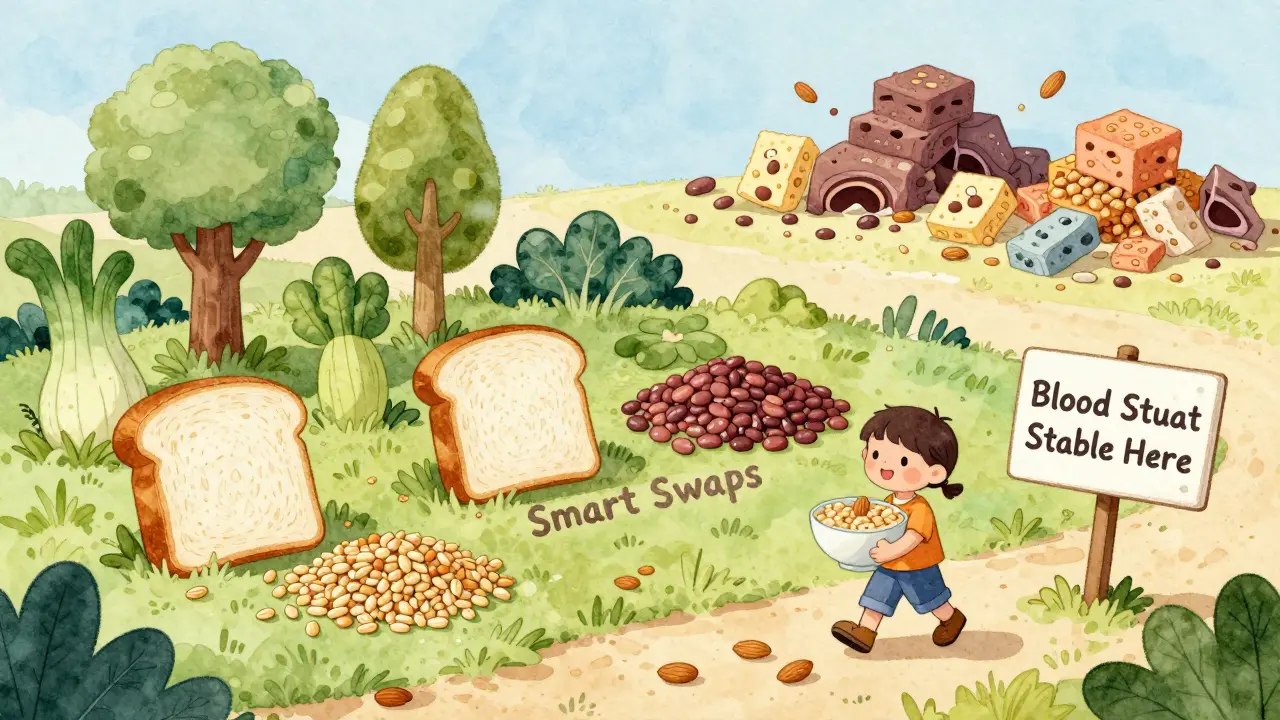
- Swap white bread for sourdough (GI=53) or whole grain rye (GI=41).
- Choose steel-cut oats over instant oatmeal (GI=83).
- Snack on apples with almond butter instead of granola bars.
- Add lentils to soups and salads instead of pasta.
- Eat your veggies first at meals-they slow down carb absorption.
You don’t need to track every bite. Just make one swap at a time. Over time, your meals will naturally become lower-GI-and your energy, hunger, and blood sugar will thank you.
Can I eat fruit on a low-GI diet?
Yes, most fruits are low-GI. Apples, pears, berries, and oranges are all under GI 40. Even bananas are moderate (GI 51 when ripe). The fiber and water content slow sugar absorption. Avoid fruit juices-they’re high-GI and stripped of fiber.
Is the low-GI diet good for weight loss?
Not on its own. When calories are equal, low-GI diets don’t lead to more weight loss than high-GI diets. But because low-GI foods are often high in fiber and protein, they help you feel full longer-which can naturally reduce calorie intake. The real benefit is in how it supports metabolism and blood sugar control, not direct fat loss.
Are all low-GI foods healthy?
No. Chocolate cake (GI=38), ice cream (GI=37), and even some sugary cereals have low GI values because of added fat or fiber. But they’re still loaded with sugar and calories. Focus on whole, unprocessed foods-not just the number.
Does cooking affect the glycemic index?
Yes, significantly. Overcooking pasta or rice raises the GI. Cooling cooked potatoes or rice turns some starch into resistant starch, lowering the GI. Al dente pasta has a GI of 45; mushy pasta is 65. How you prepare food matters as much as what you eat.
Should I count GI numbers daily?
No, unless you have diabetes. The American Diabetes Association recommends focusing on whole food sources of carbs instead of tracking GI. Choose beans, lentils, whole grains, and vegetables over refined carbs. That’s enough to get the benefits without the stress.
Final Thoughts
The low-GI diet isn’t about restriction. It’s about choosing smarter carbs. You don’t need to avoid bread or rice. Just choose whole grain, chewy, or cooled versions. You don’t need to buy special products. Just cook more at home and eat more plants. The science doesn’t support it as a weight loss miracle. But it does support it as a way to eat that protects your blood sugar, your heart, and your long-term health. That’s worth more than a few extra pounds lost.




Randall Little
January 14, 2026 AT 12:10So let me get this straight - chocolate cake has a lower GI than an apple, and we’re supposed to be impressed? The glycemic index is basically a fancy way of saying ‘fat slows sugar absorption,’ which we’ve known since the 1970s. Meanwhile, the FDA doesn’t even recognize it because it’s too inconsistent to be useful. Someone’s selling a book, and it’s not me.
Also, ‘low-GI ice cream’ is a paradox wrapped in dairy. I’ll take my 300-calorie slice of cake over your 150-calorie ‘low-GI’ oat bar any day. At least mine tastes like a crime I’m proud of.
Rosalee Vanness
January 14, 2026 AT 16:57Oh my gosh, I just read this whole thing and I’m crying a little - not because I’m sad, but because I finally feel seen. For years I’ve been eating steel-cut oats with chia seeds and a handful of blueberries, and my mom kept saying, ‘Why don’t you just eat the granola? It’s quicker!’ And I’d just smile and nod, because I knew the difference between a food that fuels you and a food that just makes you hungry again in 45 minutes.
It’s not about the numbers. It’s about the rhythm. The quiet hum of your body saying, ‘I’m not being tricked.’ That’s the real magic. I don’t track GI. I track how I feel after I eat. And if I’m not reaching for a snack at 3 p.m.? That’s the win. Not the scale. Not the chart. Just… peace.
Thank you for writing this. I needed to hear it today.
Also, if you’re eating lentils and feeling like a monk, you’re doing it right. You’re not starving. You’re savoring.
mike swinchoski
January 15, 2026 AT 03:03People are stupid. You think eating beans makes you healthy? I ate a whole bag of roasted chickpeas last week and gained 3 pounds. GI doesn’t matter. Calories do. If you eat too much of anything, you get fat. End of story. Stop overcomplicating food. Just eat less and move more. That’s what my grandpa did. He lived to 98. He never heard of glycemic index.
Also, why is everyone so obsessed with ‘whole grains’? White bread tastes better. Who cares if it spikes your sugar? You’re not diabetic. Stop being a nutrition Nazi.
Trevor Whipple
January 16, 2026 AT 04:57ok so i just read this whole thing and i think the author is a total genius but also kinda missing the point. like yeah low-gi foods are good for blood sugar but if you’re eating a bunch of low-gi processed crap like sugar-free gummies or ‘diet’ pasta with 12 ingredients you’re still screwed. i switched to eating whole foods and just stopped counting everything and lost 20 lbs in 4 months. no gi chart needed. also i eat ice cream every night and my hba1c is 5.2. so maybe the real secret is just don’t be a robot about food. also typo: ‘chickeas’ lol
ps: i’m not diabetic but i still eat lentils because they taste like earth and i like that.
Lethabo Phalafala
January 16, 2026 AT 06:46My grandmother in Johannesburg used to say, ‘If it looks like it came from a factory, don’t eat it.’ And she was right. I used to think low-GI meant buying expensive ‘superfood’ labels - until I realized I could get the same benefits from dried beans I cooked myself, or the sweet potatoes my neighbor gives me from her garden.
I’ve been prediabetic for five years. I swapped white rice for barley. I eat my veggies first. I stopped drinking juice. And in six months, my fasting sugar dropped from 112 to 89. No meds. No obsession. Just real food.
Stop listening to influencers. Listen to your body. And if you’re too busy to cook? Start with one meal a week. One. That’s all it takes to begin healing.
I’m not here to judge. I’m here to say: you can do this. Not perfectly. Just consistently.
Damario Brown
January 16, 2026 AT 08:27you’re all missing the real problem: insulin resistance isn’t caused by GI. it’s caused by chronic hyperinsulinemia from constant snacking and carb-loading. the gi is just a distraction. people think ‘low-gi’ = safe to eat anytime, so they eat 6 low-gi meals a day. that’s worse than eating 2 high-gi meals. your pancreas doesn’t care if the sugar comes from an apple or a cake - it just cares how often you flood it.
also, the ‘resistant starch’ thing? that’s just a marketing ploy. cooling rice lowers gi by 15%? big deal. you still ate 300 calories of carbs. you think that’s going to reverse metabolic syndrome? please. eat less. move more. sleep. stop overthinking.
John Pope
January 18, 2026 AT 04:02Here’s the philosophical truth nobody wants to admit: the glycemic index is a lie we tell ourselves to feel in control. We live in a world that tells us every choice must be quantified - calories, macros, GI, net carbs, bioavailability. But the body isn’t a spreadsheet. It’s a symphony. One note doesn’t define the piece.
When you eat a bowl of lentils, you’re not just consuming carbohydrates. You’re engaging with a 10,000-year-old relationship between humans and soil. You’re tasting history. You’re honoring the labor of farmers who never heard of the WHO.
Low-GI isn’t a diet. It’s a meditation. A quiet rebellion against the industrialization of hunger.
...I’m sorry. I got carried away. But you asked for truth. Not numbers.
Adam Vella
January 19, 2026 AT 12:21While the article presents a well-researched and balanced perspective, it fails to adequately address the role of individual metabolic variability in glycemic response. Recent studies using continuous glucose monitors (CGMs) have demonstrated that inter-individual glycemic responses to identical foods can vary by up to 40%, rendering population-based GI tables statistically irrelevant for personalized nutrition.
Furthermore, the conflation of ‘low-GI’ with ‘whole foods’ introduces a significant confounding variable. The observed health benefits are likely attributable to increased fiber density, reduced glycemic load, and decreased ultra-processed food consumption - not the GI value per se.
Therefore, I propose a paradigm shift: replace GI-based dietary guidance with a focus on nutrient density, food processing level, and meal timing - all of which have stronger empirical support in metabolic health literature.
Alan Lin
January 21, 2026 AT 01:49Thank you for this. As a clinical nutritionist with 22 years of experience, I’ve seen patients ruin their relationship with food trying to track GI values. I tell them: if you’re eating vegetables, legumes, whole grains, nuts, and fruits - and avoiding sugary drinks and white flour - you’re already winning.
There is no ‘perfect’ diet. There is only a sustainable one. And sustainability doesn’t come from charts. It comes from joy. From flavor. From sitting down to eat without guilt.
I’ve had patients reverse type 2 diabetes without ever checking a GI number. They just started cooking. They started eating slowly. They started listening.
You don’t need to be a scientist to eat well. You just need to care.
Robin Williams
January 22, 2026 AT 16:30bro i used to think i had to eat like a monk to be healthy - quinoa bowls, almond butter, cold brew everything - until i realized i just needed to stop eating sugar and start eating food that doesn’t come in a bag. i started eating beans with rice and it changed my life. no more 3pm crashes. no more cravings. just… chill.
also i eat ice cream sometimes. and i’m still not fat. weird right? maybe the real low-gi diet is just not being a stress monster. your body knows. trust it.
Kimberly Mitchell
January 24, 2026 AT 03:54GI is a marketing tool created by cereal companies to sell more ‘whole grain’ products. If you’re not diabetic, stop caring. The only thing that matters is total calorie intake and protein quality. Everything else is noise. This article is overthought. Just eat less junk. Done.
Vinaypriy Wane
January 25, 2026 AT 00:30Thank you for this. Truly. In India, we’ve eaten dal, rice, and curd for centuries - not because of science, but because it works. My grandfather ate white rice daily and lived to 94. He didn’t know what GI was. But he never ate sugar. He never ate fried snacks. He ate slowly. He ate with family. He moved every day.
Maybe the answer isn’t in the index. Maybe it’s in the rhythm.
I’ve started cooking lentils twice a week. I eat them with spinach and a spoon of ghee. My blood sugar? Steady. My soul? Calmer.
Let’s stop making food complicated. Let’s just eat like our ancestors did - with care, not charts.
Diana Campos Ortiz
January 26, 2026 AT 10:54I used to think I had to be perfect - no sugar, no bread, no fun. Then I started eating sourdough toast with avocado and a poached egg on weekends. No guilt. Just joy. My energy didn’t crash. My cravings vanished. I didn’t lose weight - but I stopped hating my body.
Maybe the real low-GI diet is just… being kind to yourself.
Also, I still eat chocolate. But I pick dark. And I savor it. Like it’s a gift. Not a crime.
Thank you for reminding me that food isn’t the enemy.
Randall Little
January 27, 2026 AT 19:33Wow. Someone actually said it. I’ve been saying this for years: the only thing lower GI than a banana is a banana smoothie. And guess what? That’s what people drink for ‘health.’
Also, ‘resistant starch’ is just science-speak for ‘leftover rice.’ You don’t need a PhD to know that. Just a fridge and a sense of humor.