2
Magnesium Supplements and Osteoporosis Medications: What You Need to Know About Timing
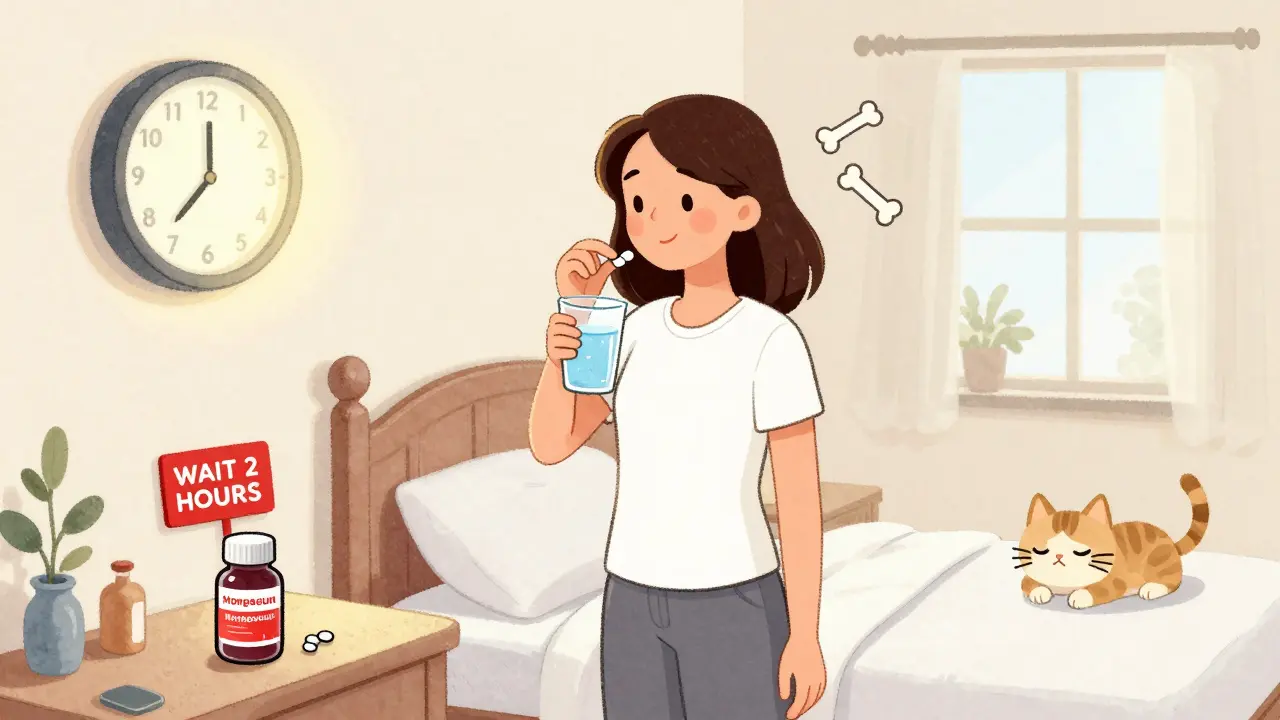
Why Timing Matters Between Magnesium and Osteoporosis Pills
If you're taking a bisphosphonate like Fosamax or Actonel for osteoporosis, and you also take magnesium supplements for muscle cramps, sleep, or general health, you might be accidentally sabotaging your treatment. It’s not that these two are dangerous together - it’s that they stop each other from working. Magnesium binds to bisphosphonates in your gut, forming a substance your body can’t absorb. That means the drug meant to strengthen your bones ends up passing right through you, useless.
This isn’t a myth or a vague warning. Studies show that when magnesium and bisphosphonates are taken too close together, the effectiveness of the osteoporosis medication drops by up to 60%. For someone already at risk of fractures, that’s not just inconvenient - it’s dangerous. The National Osteoporosis Foundation reports that 10.2 million Americans have osteoporosis, and nearly half of them are on bisphosphonates. If you’re one of them and you’re also taking magnesium, you need to know the exact timing rules - and why they exist.
How Magnesium Blocks Osteoporosis Drugs
The science behind this interaction is simple but powerful. Bisphosphonates work by sticking to bone tissue and slowing down cells that break down bone. But to get there, they first need to be absorbed through your stomach and intestines. These drugs are already poorly absorbed - only about 1% of what you swallow actually enters your bloodstream. Now add magnesium, and it gets worse.
Magnesium ions (Mg²⁺) latch onto the phosphonate groups in drugs like alendronate and risedronate. This creates an insoluble complex - like mixing salt and baking soda and ending up with a chalky lump that won’t dissolve. Your body can’t absorb this lump. So instead of reaching your bones, the drug ends up in your toilet. A 1994 Merck study, cited in the FDA’s official prescribing info for Fosamax, showed a 40-60% drop in absorption when magnesium was taken at the same time. More recent research from the Journal of Bone and Mineral Research in 2018 confirmed this across 17 clinical trials.
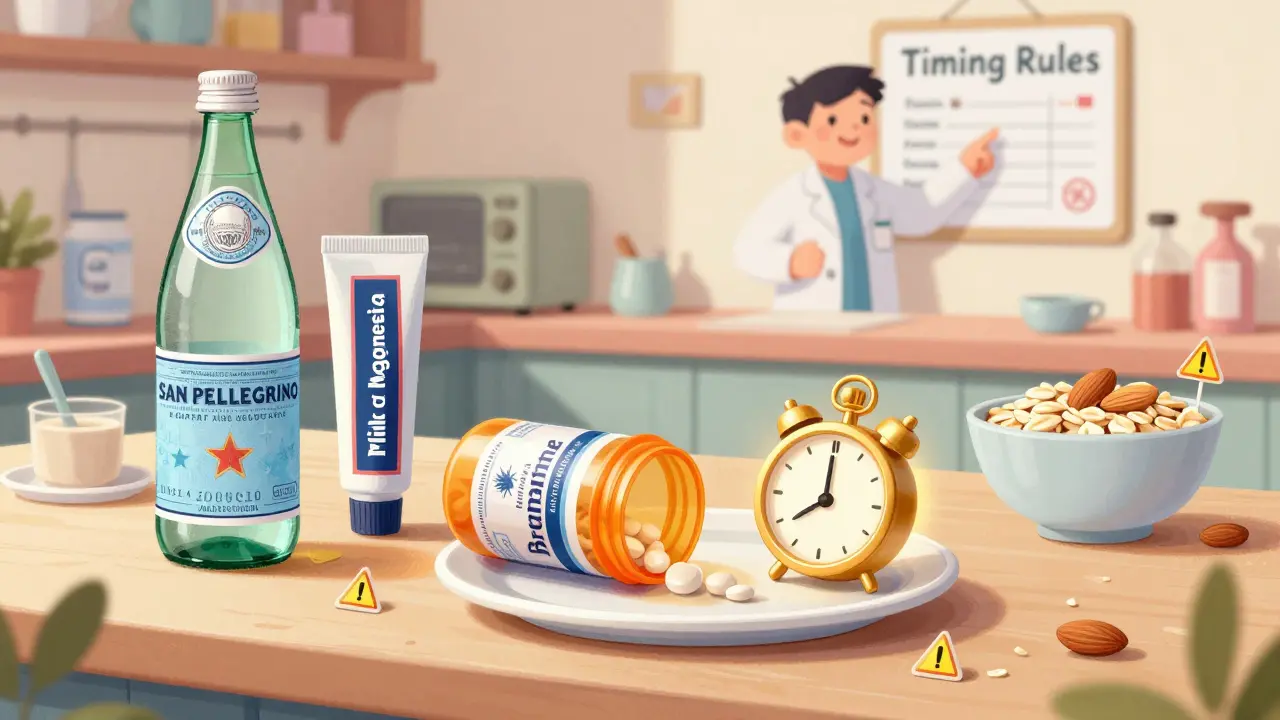
This isn’t just about supplements. Many people don’t realize that common over-the-counter products like Milk of Magnesia (an antacid) or magnesium-based laxatives contain high doses of magnesium - sometimes 800mg per teaspoon. Even some bottled waters, like San Pellegrino, contain small amounts (51mg per liter). If you’re drinking that water with your bisphosphonate, you’re still risking reduced absorption.
The 2-Hour Rule: What Experts Agree On
There’s one clear, consistent rule across every major medical source: Take magnesium at least two hours before or after your bisphosphonate. This isn’t a suggestion - it’s a requirement for the drug to work.
- The NIH Office of Dietary Supplements (2023) says: “Bisphosphonates are not well absorbed when taken too soon before or after taking dietary supplements or medications with high amounts of magnesium.”
- WebMD’s drug database (updated October 2023) states: “Bisphosphonates should be taken at least two hours before or after magnesium supplementation.”
- Health Central Network’s 2023 clinical review confirms: “At least 2-hour separation to maintain osteoporosis treatment efficacy.”
This two-hour window isn’t arbitrary. It’s based on how long it takes for your stomach to empty after taking a pill. Most substances clear the stomach within 1-2 hours. Waiting two hours ensures the bisphosphonate has already moved into the small intestine - where it’s mostly absorbed - before magnesium enters the system.
Important note: This rule applies only to oral bisphosphonates - alendronate (Fosamax), risedronate (Actonel), ibandronate (Boniva). If you’re on an IV bisphosphonate like Reclast (zoledronic acid), you don’t need to worry. Those go straight into your bloodstream, bypassing your gut entirely.
Real People, Real Mistakes
People aren’t being careless on purpose. They just don’t know.
A 2022 survey by the National Osteoporosis Foundation found that 37% of patients taking both magnesium and bisphosphonates didn’t know about the interaction. Twenty-two percent admitted they took them together. On Reddit’s r/Osteoporosis community, one user wrote: “I took Fosamax and magnesium for restless legs for six months. My bone density didn’t budge. My doctor said it was probably because I didn’t space them out.”
Another common mistake? Using antacids. Many patients take Maalox or Mylanta for heartburn, not realizing those contain magnesium. One Drugs.com forum thread had over 1,200 comments from people who didn’t connect their daily Tums-like pills with their osteoporosis treatment failure.
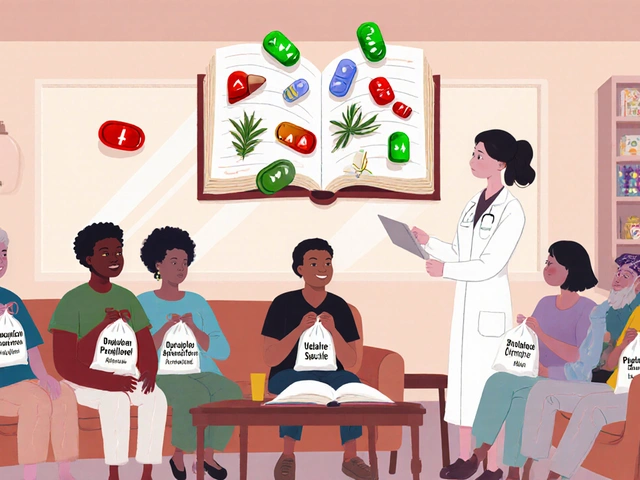
On the flip side, patients who got clear instructions had much better results. A Kaiser Permanente survey in late 2023 showed 89% adherence among those who received written timing instructions, compared to just 43% who only got verbal advice. Simple, printed guides make a huge difference.
How to Actually Follow the Rules
Here’s a step-by-step plan that works - especially if you’re juggling multiple medications.
- Morning: Take your bisphosphonate first. Do this right after waking up, with a full glass (8 oz) of plain water. Stay upright for at least 30 minutes - no lying down, no eating, no drinking anything else.
- Wait 30 minutes. This is the standard requirement for bisphosphonates to be absorbed properly.
- Wait another 90 minutes. That brings you to a full 2 hours after taking the bisphosphonate. Now it’s safe to take magnesium.
- Take your magnesium supplement. This can be with food or on an empty stomach - timing doesn’t matter for magnesium, only for the bisphosphonate.
- Log it. Use a small notebook or phone app to note what you took and when. This helps you stay consistent and gives your doctor a clear picture.
Many people use pill organizers, but standard AM/PM boxes won’t cut it. You need a 4-compartment organizer labeled: AM Medication, AM Supplement, PM Medication, PM Supplement. Some pharmacies now offer these for free with a prescription.
Visual aids help too. A “timing wheel” - a simple paper circle with time slots - pinned to your fridge can be more effective than written instructions. A 2023 study in the American Journal of Health-System Pharmacy found 67% of patients followed the rule with a visual guide, versus 32% with paper handouts.
What Else Contains Magnesium? (The Hidden Sources)
Don’t just check your supplement bottle. Look everywhere.
- Antacids: Milk of Magnesia, Maalox, Mylanta - each contains 300-800mg magnesium per dose.
- Laxatives: Many over-the-counter constipation remedies use magnesium citrate or hydroxide.
- Bottled water: San Pellegrino, Perrier, and some mineral waters list magnesium on the label. Even small amounts add up if you drink several bottles a day.
- Multivitamins: Many include magnesium. Check the label - if it says “magnesium oxide” or “magnesium citrate,” it counts.
- Protein powders and meal replacements: Some brands add magnesium for “electrolyte balance.”
If you’re unsure, read the “Supplement Facts” panel. Look for magnesium in any product you take daily. If it’s more than 50mg per serving, treat it like a supplement and space it out.
What’s Changing in 2026?
The problem is getting more common - and more visible.
Magnesium supplement sales hit $587 million in the U.S. in 2023, up 14.3% from the year before. Bisphosphonate prescriptions remain steady at over 22 million per year. That means more people are taking both - and more are at risk.
Pharmacies are responding. The National Community Pharmacists Association reports a 28% increase in interaction consultations since 2020. Electronic health records like Epic and Cerner now flag this interaction automatically. If your doctor prescribes Fosamax and you’re already on magnesium, the system will pop up a warning.
Even packaging is changing. The FDA now requires “Take at least 2 hours apart” warnings on both bisphosphonate and magnesium supplement labels. Full rollout isn’t complete until 2025, but you’ll start seeing it more often.
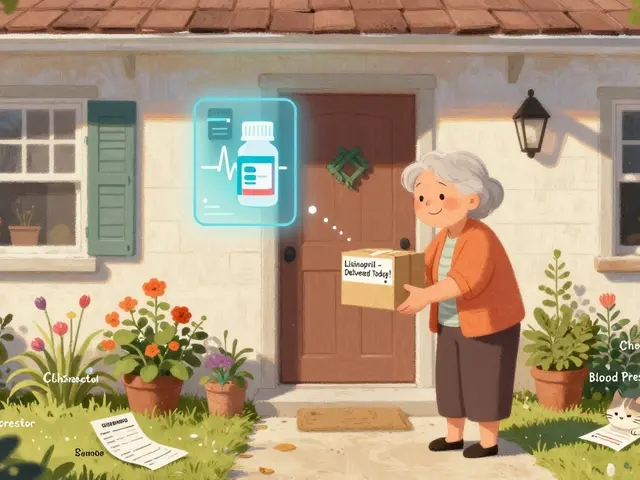
Future solutions are coming too. Merck is testing a new time-release bisphosphonate (ALN-103) designed to be less affected by minerals. And smart pill bottles - like the ones used in a Mayo Clinic pilot - send reminders to your phone and track when you take your meds. In that study, adherence jumped to 92%.
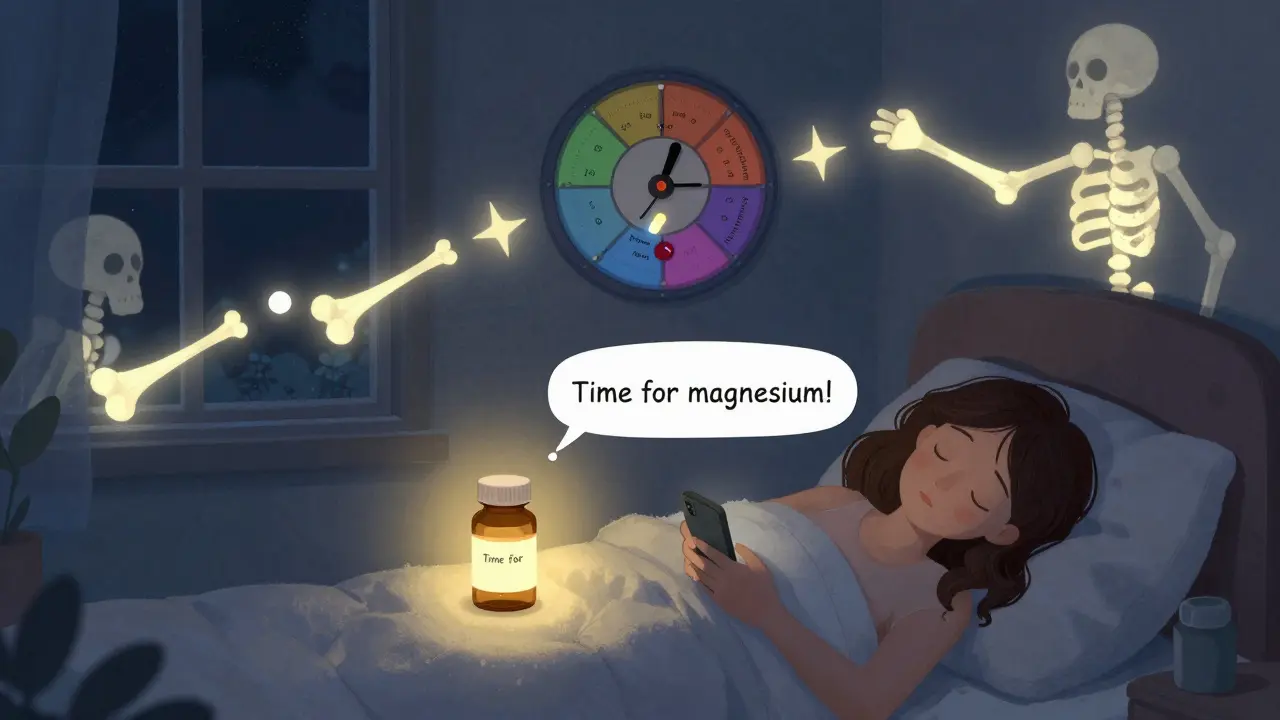
What Happens If You Ignore This?
Ignoring the timing rule doesn’t cause side effects - it causes treatment failure.
When bisphosphonates don’t absorb properly, your bones keep breaking down faster than they rebuild. Over time, your bone density drops. Fracture risk goes up. A 2021 study from Creighton University found that patients who spaced their magnesium and bisphosphonates correctly had 8.2% greater improvement in spine bone density over two years than those who didn’t.
The Institute for Safe Medication Practices calls this a “high-alert” interaction. It accounts for 12% of all reported osteoporosis treatment failures. And it’s completely preventable.
Dr. Felicia Cosman, clinical director of the National Osteoporosis Foundation, put it bluntly: “Non-adherence to bisphosphonate dosing protocols is the single largest preventable cause of treatment failure in osteoporosis management.”
You’re not failing because you’re lazy. You’re failing because you weren’t told the full story.
What About Natural Sources of Magnesium?
Some alternative health sites claim that magnesium from food - like spinach, almonds, or black beans - doesn’t interfere with bisphosphonates. That’s misleading.
Food magnesium is absorbed slowly and in smaller amounts. But if you’re eating a magnesium-rich meal right before or after your pill, it can still affect absorption. The FDA and American College of Rheumatology don’t make exceptions for food sources. If you’re taking your bisphosphonate at 7 a.m., wait until at least 9 a.m. before eating a big bowl of oatmeal with almonds and banana.
There’s no clinical evidence supporting “natural is safe.” Stick to the two-hour rule - whether your magnesium comes from a pill, a powder, or a banana.
Final Checklist: Your Action Plan
- ✅ Know your bisphosphonate: Is it oral (Fosamax, Actonel) or IV (Reclast)? Only oral needs spacing.
- ✅ List every magnesium source: Supplements, antacids, laxatives, bottled water, multivitamins.
- ✅ Take bisphosphonate first thing in the morning with plain water.
- ✅ Wait 30 minutes before eating or drinking anything else.
- ✅ Wait a full 2 hours after your bisphosphonate before taking magnesium.
- ✅ Use a pill organizer with 4 compartments or a timing wheel.
- ✅ Talk to your pharmacist every time you get a new medication.
- ✅ Log your doses for at least one month - it helps you spot patterns.
This isn’t about being perfect. It’s about being consistent. One slip-up won’t ruin your treatment. But doing it wrong every day? That’s how fractures happen.
Can I take magnesium and bisphosphonates at the same time if I drink a lot of water?
No. Drinking water doesn’t prevent the chemical reaction between magnesium and bisphosphonates. The binding happens in your stomach and intestines regardless of fluid volume. Even with a full glass of water, taking them together still cuts absorption by 40-60%. Always wait two hours.
What if I forget and take them together by accident?
Don’t panic. One mistake won’t undo months of treatment. But don’t take another dose to “make up for it.” Just skip your magnesium that day, and go back to your regular schedule tomorrow. The goal is long-term consistency, not perfection.
Can I take magnesium at night instead of in the morning?
Yes - and it’s actually a good idea. Many people take magnesium at night because it helps with sleep. If you take your bisphosphonate in the morning, you can safely take magnesium at bedtime. Just make sure there’s at least two hours between your last meal or drink (except water) and your magnesium dose. This avoids any overlap with your morning drug.
Are all magnesium supplements the same?
In terms of interaction, yes. Whether it’s magnesium citrate, oxide, glycinate, or chloride - they all release magnesium ions in the gut. That’s what binds to the bisphosphonate. The form affects absorption and side effects (like diarrhea), but not the drug interaction. All forms need the same two-hour separation.
Should I stop taking magnesium altogether?
No. Magnesium is important for muscle function, nerve signaling, and heart health. The goal isn’t to quit it - it’s to time it right. Many people need magnesium supplements, especially older adults. Just separate it from your osteoporosis pill by two hours. You don’t have to choose one over the other.
What if my doctor didn’t mention this?
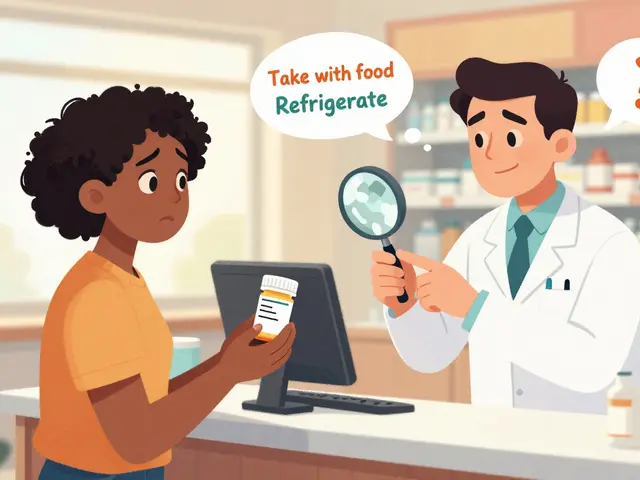
Talk to your pharmacist. Doctors are often focused on the main diagnosis and may overlook supplement interactions. Pharmacists are trained to catch these details. When you pick up your bisphosphonate, ask: “Does this interact with any supplements I take?” Most will check your full list and give you clear timing instructions.







Antwonette Robinson
February 4, 2026 AT 08:02Thanks for actually citing studies instead of just saying ‘trust me bro.’
Ed Mackey
February 5, 2026 AT 20:12but then i checked my bottle and saw it says ‘take on empty stomach’ so i guess i’ve been doing it right? idk. my doctor never said anything.
also my water has mag in it? really? 😳
Jamillah Rodriguez
February 5, 2026 AT 23:16So I guess I’m basically a walking osteoporosis billboard now? 🤡
Also, why is everyone so calm about this? I’m 62 and I just realized I’ve been sabotaging my bones for 3 years. I need a drink.
Susheel Sharma
February 7, 2026 AT 05:56However, the real issue here is systemic healthcare neglect - patients are not being educated, pharmacists are overworked, and physicians rely on fragmented EHR alerts.
It’s not the patient’s fault. It’s the system’s failure. 🧠💊
Janice Williams
February 7, 2026 AT 23:58My holistic healer said bisphosphonates are toxic and cause jaw necrosis - so I stopped them entirely. And I eat kale. My bones are fine.
Roshan Gudhe
February 8, 2026 AT 02:31But maybe the real question isn’t about timing… it’s about why we’re so disconnected from our own biology.
What if we stopped treating symptoms and started asking why our bones are crumbling in the first place?
Rachel Kipps
February 9, 2026 AT 13:24im gonna start using the 4-compartment organizer. and i’ll log it.
also… i didn’t know san pellegrino had mag. 🤯
Wendy Lamb
February 11, 2026 AT 07:33Easy. Effective. No stress.
Katherine Urbahn
February 11, 2026 AT 20:55Furthermore, citing Reddit threads as evidence?
And suggesting that ‘visual guides’ are superior to clinical guidance?
This is not medicine - it’s misinformation dressed up as helpful advice.
Meenal Khurana
February 13, 2026 AT 06:21Simple. Works.
Joy Johnston
February 14, 2026 AT 02:39Patients don’t know about the interaction because no one told them - not their doctor, not their pharmacy tech, not even the label on the bottle (until recently).
But here’s the good news: once they hear it clearly, 90% of them get it right.
Printed timing charts? Game-changer.
Also - yes, even the banana at breakfast can interfere if eaten within 2 hours. It’s not just pills.
Shelby Price
February 14, 2026 AT 14:51or do i need to switch to tap water? 😅