18
Shift Work Sleep Disorder: How to Manage Night Shifts and Get Real Sleep

Working nights isn’t just inconvenient-it’s physically hard on your body. If you’ve ever tried to sleep during the day after a 12-hour shift, only to wake up exhausted, groggy, or wide awake at 3 p.m., you’re not alone. You might be dealing with shift work sleep disorder (SWSD), a real medical condition recognized by the American Academy of Sleep Medicine and the World Health Organization. It’s not laziness. It’s not poor discipline. It’s your internal clock fighting against your schedule.
What Exactly Is Shift Work Sleep Disorder?
SWSD happens when your work schedule clashes with your body’s natural sleep-wake cycle. Your brain is wired to sleep at night and be awake during the day. When you’re forced to work from 11 p.m. to 7 a.m. and then try to sleep while the sun is up, your body doesn’t adapt easily. This misalignment throws off key hormones like melatonin and cortisol, which control sleep and alertness.
According to the CDC, nearly 30% of night shift workers and 24% of rotating shift workers experience moderate to severe sleepiness during work hours. That’s more than 4 million Americans who are dangerously tired on the job. The National Safety Council estimates fatigue-related errors cost U.S. businesses $13 billion a year. And it’s not just about accidents-SWSD is linked to higher risks of heart disease, diabetes, obesity, and even certain cancers. The International Agency for Research on Cancer classifies shift work as “probably carcinogenic” because of how deeply it disrupts biology.
How Do You Know If You Have It?
SWSD isn’t just feeling tired after a long night. It’s a persistent pattern. If you’ve had these symptoms for at least a month (some guidelines say three months), you might have SWSD:
- Struggling to fall or stay asleep during the day, even when you have the time and quiet
- Feeling extremely sleepy or falling asleep during your shift
- Needing caffeine just to stay awake at work
- Having trouble concentrating, remembering things, or making decisions
- Feeling irritable, anxious, or depressed
- Experiencing headaches, stomach issues, or weakened immunity
Many people think they can “get used to” night shifts. But research from Brigham and Women’s Hospital shows only 2-5% of night shift workers ever fully adapt their circadian rhythm-even after years on the schedule. The rest are running on borrowed sleep, and their bodies know it.
Why Your Body Won’t Adapt (Even After Years)
Your circadian rhythm is controlled by a tiny part of your brain called the suprachiasmatic nucleus (SCN). It responds to light-especially blue light from the sun. When it’s dark, your body releases melatonin to make you sleepy. When it’s light, melatonin drops and cortisol rises to wake you up.
But artificial light at night messes this up. If you’re working under bright lights from 11 p.m. to 7 a.m., your brain thinks it’s daytime. So melatonin stays low. Then, when you get home, you try to sleep in a bright room. Even a little sunlight sneaking through the blinds can block melatonin by up to 85%, according to the Journal of Biological Rhythms. You’re fighting biology with blackout curtains and white noise machines-and it’s not enough.
And it’s not just light. Your social life gets tangled. Family dinners, weekend plans, even your partner’s sleep schedule-all get disrupted. One nurse on Reddit wrote: “I work nights, have blackout curtains, a sleep mask, and white noise. Still only get 4 hours. I’m exhausted all the time.” That’s not unusual. The average SWSD patient loses 1-4 hours of sleep per night.
What Actually Works to Manage It
There’s no magic pill, but science-backed strategies can help you reclaim your sleep and stay alert at work. Here’s what works, based on clinical guidelines from the American Academy of Sleep Medicine and real-world results from nurses, firefighters, and factory workers.
1. Light Therapy: Trick Your Brain Into Thinking It’s Night
Use bright light (2,000-10,000 lux) during your night shift. A 30-minute session every 2 hours can reset your internal clock. Many hospitals now use light boxes in break rooms. If your workplace doesn’t provide them, consider a personal light therapy lamp. Use it from the start of your shift until your last hour. This tells your brain: “It’s daytime. Stay awake.”
Then, when you’re heading home, wear blue-light-blocking glasses. These are the same ones used by pilots and astronauts. They filter out the wavelengths that suppress melatonin. You can get them for under $30 online. Wear them for the last 30-60 minutes of your commute.
2. Melatonin: The Sleep Hormone You Can Supplement
Take 0.5 to 5 mg of melatonin 30 minutes before your daytime sleep. It’s not a sleeping pill-it’s a signal to your body that it’s time to wind down. Studies show it helps people fall asleep faster and sleep longer during the day. Start with the lowest dose. Too much can make you groggy or give you weird dreams.
Timing matters. Take it right before you lie down-not before your shift. If you take it too early, your body will think it’s bedtime during work, and you’ll feel drowsy on the job.
3. Caffeine: Use It Like a Tool, Not a Crutch
Caffeine works-but only if you use it right. Limit it to the first half of your shift. No coffee after 3 a.m. if your shift ends at 7 a.m. That way, it wears off before you try to sleep. One study found that nurses who followed this rule improved alertness by 68%.
Don’t chug energy drinks. Stick to coffee or tea. Max out at 200 mg per dose (about two cups of coffee). Too much caffeine can wreck your sleep even more.
4. Strategic Napping: Power Up Before You Go
A 20-30 minute nap before your shift can dramatically improve alertness. If your workplace allows it, nap during your break. Even 10 minutes helps. NASA found that a 26-minute nap improved pilot performance by 34% and alertness by 54%. You don’t need a bed-just a quiet, dark corner.
Don’t nap after your shift. That’s when your body is trying to fall asleep. Napping then can delay your sleep onset.
5. Sleep Environment: Turn Your Bedroom Into a Cave
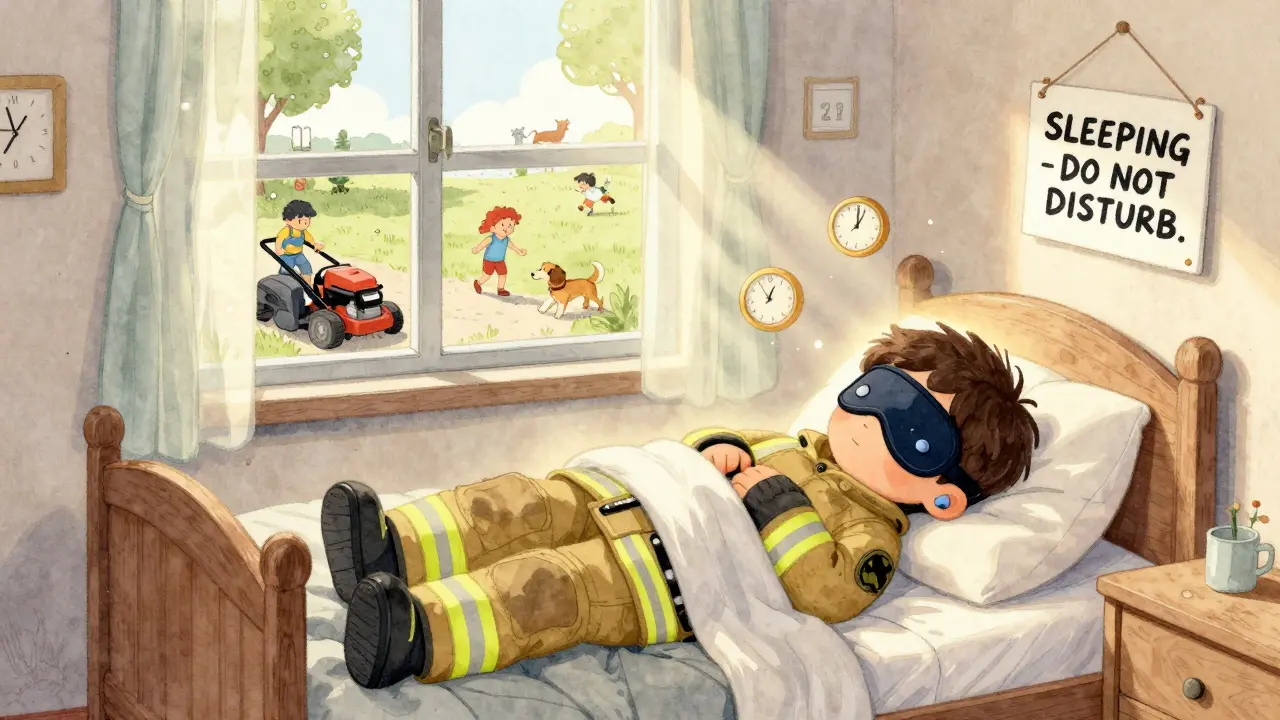
Darkness is non-negotiable. Use blackout curtains, a sleep mask, and cover any LED lights (TVs, chargers, smoke detectors). Use earplugs or white noise to block sounds-kids, traffic, lawnmowers. Keep the room cool (around 65°F). Your body needs a drop in temperature to sleep well.
Let people know your sleep schedule. Tell family, roommates, neighbors. Put a sign on your door. Sleep is your job now, too.

What Doesn’t Work (And Why)
Some common advice makes things worse.
- “Just sleep more on your days off.” Trying to catch up on sleep over the weekend doesn’t fix circadian misalignment. You’ll end up with “social jet lag”-feeling out of sync every Monday.
- “Take sleeping pills.” Prescription sleep aids don’t fix the root problem. They mask symptoms and can be habit-forming. They don’t restore natural sleep architecture.
- “Work fewer nights.” Rotating shifts are worse than fixed ones. Your body can’t adapt if your schedule keeps changing. If you can, stick to one shift pattern-either nights or days.
Who’s Most at Risk?
Not everyone reacts the same way. Some people naturally stay up later-these are “night owls.” Research from the University of Munich found night owls adapt to night shifts 37% better than “morning larks.” If you’ve always been the last one awake at parties, you might handle nights better.
Women are 28% more likely to develop SWSD than men, possibly due to hormonal differences. And as you age, your body’s ability to adapt declines. Workers aged 50-64 are twice as likely to have SWSD as those under 30.
Healthcare workers, firefighters, truck drivers, and factory staff are hit hardest. But so are warehouse workers, call center employees, and grocery store staff working late shifts.
What Employers Should Do (And Often Don’t)
Most companies don’t offer any support. Only 22% of shift workers report having access to quiet, dark sleeping facilities on-site, according to NIOSH. That’s unacceptable.
Good employers:
- Provide bright light exposure during night shifts
- Allow short naps during breaks
- Limit consecutive night shifts to 3-4
- Give rotating shift workers at least 48 hours off between schedule changes
- Offer education on sleep hygiene and circadian health
The return on investment is clear. For every $1 spent on SWSD management, companies save $5.20 in reduced errors, absenteeism, and workers’ compensation claims. Yet only 47% of major hospitals now screen for SWSD-up from 12% in 2018. Progress is slow, but it’s happening.
New Treatments on the Horizon
In May 2023, the FDA approved sodium oxybate for SWSD-related excessive sleepiness. It’s a powerful medication, used under strict supervision. It’s not for everyone, but it’s another tool.
Researchers are also testing personalized treatments based on your genes. Variations in the PER3 and CLOCK genes affect how well you adapt to night shifts. In the next few years, you might get a genetic test to see if night work is even a good fit for you.
Wearable tech is catching up too. Companies are developing devices that track your body temperature, heart rate variability, and light exposure to predict when you’re most alert or most at risk of fatigue. By 2025, 68% of major healthcare systems plan to use these for employee health programs.
When to See a Doctor
If you’ve tried the strategies above for 4-6 weeks and still can’t sleep or stay awake, it’s time to see a sleep specialist. They can confirm SWSD with a sleep log or actigraphy monitor (a wrist device that tracks movement and light exposure over 7-14 days).
Don’t wait until you’ve had a near-miss at work, or your health starts declining. SWSD is treatable-but only if you address it early.
Final Thought: You’re Not Broken
Working nights isn’t a personal failure. Your body isn’t weak. It’s just being asked to do something it wasn’t built for. The real problem isn’t you-it’s a 24/7 economy that treats human biology as an afterthought.
But you can fight back. With the right tools-light, melatonin, caffeine, naps, and a dark room-you can protect your sleep, your health, and your safety. You don’t have to quit your job. You just need to treat your sleep like the priority it is.
Start small. Pick one strategy this week-maybe the blackout curtains or the morning melatonin. Do it consistently. Your body will thank you.





Gloria Parraz
December 18, 2025 AT 18:20This post hit me right in the soul. I’ve been on nights for 8 years. Blackout curtains, sleep mask, white noise, melatonin - I’ve tried it all. Still wake up at 3 p.m. feeling like I ran a marathon in my pajamas. It’s not laziness. It’s biology. And nobody talks about how lonely it gets when everyone else is living their life while you’re sleeping through it.
Sahil jassy
December 20, 2025 AT 11:32melatonin 1mg before bed works for me. no more coffee after 2am. light glasses on way home. simple. no drama. just sleep.
Janelle Moore
December 21, 2025 AT 17:40you know what they dont tell you? the government is using shift work to control the population. melatonin is fake. its all a cover for the 5g towers in your ceiling that mess with your pineal gland. they want you tired so you dont think. blackout curtains? they still get in through the walls. i tested it with my ham radio. the signals are stronger at 4am. wake up sheeple.
Chris porto
December 22, 2025 AT 10:23It’s funny how we treat the body like a machine you can just reprogram. We expect it to adapt to chaos, then blame ourselves when it breaks. Maybe the real problem isn’t how we sleep - but why we’re forced to work when our species evolved to rest at night. The economy runs on stolen sleep. And we’re the ones paying for it with our health.
Danielle Stewart
December 23, 2025 AT 03:16As a nurse manager, I’ve seen too many colleagues burn out from this. We now have light therapy stations in our break room and mandatory nap pods after 4 a.m. shifts. It’s not just nice - it’s necessary. If your employer doesn’t offer this, ask. Politely. Repeatedly. Your life depends on it.
jessica .
December 23, 2025 AT 17:12they say its circadian rhythm but i think its the fluoro light poisoning. they put it in every workplace to make us docile. and now they sell you glasses to block it like its your fault. wake up. the same people who make you work nights also sell you melatonin pills. its a scam. they want you dependent. dont buy the lie.
Ryan van Leent
December 24, 2025 AT 01:17why are you even working nights if you hate it so much? just get a normal job. everyone else does. you think the world owes you a good sleep schedule? get real. if you can't handle it then maybe you're just not cut out for it. stop making it a medical issue. its called discipline.
Adrienne Dagg
December 24, 2025 AT 06:47just got my blue light glasses today 🥹✨ and i already feel like a new person. no more 3pm crashes. also told my roommate i’m sleeping from 9am-5pm and they actually listened. i’m crying. this post saved me 💖