14
Arthritis Types Explained: Osteoarthritis vs. Rheumatoid Arthritis and Other Common Forms
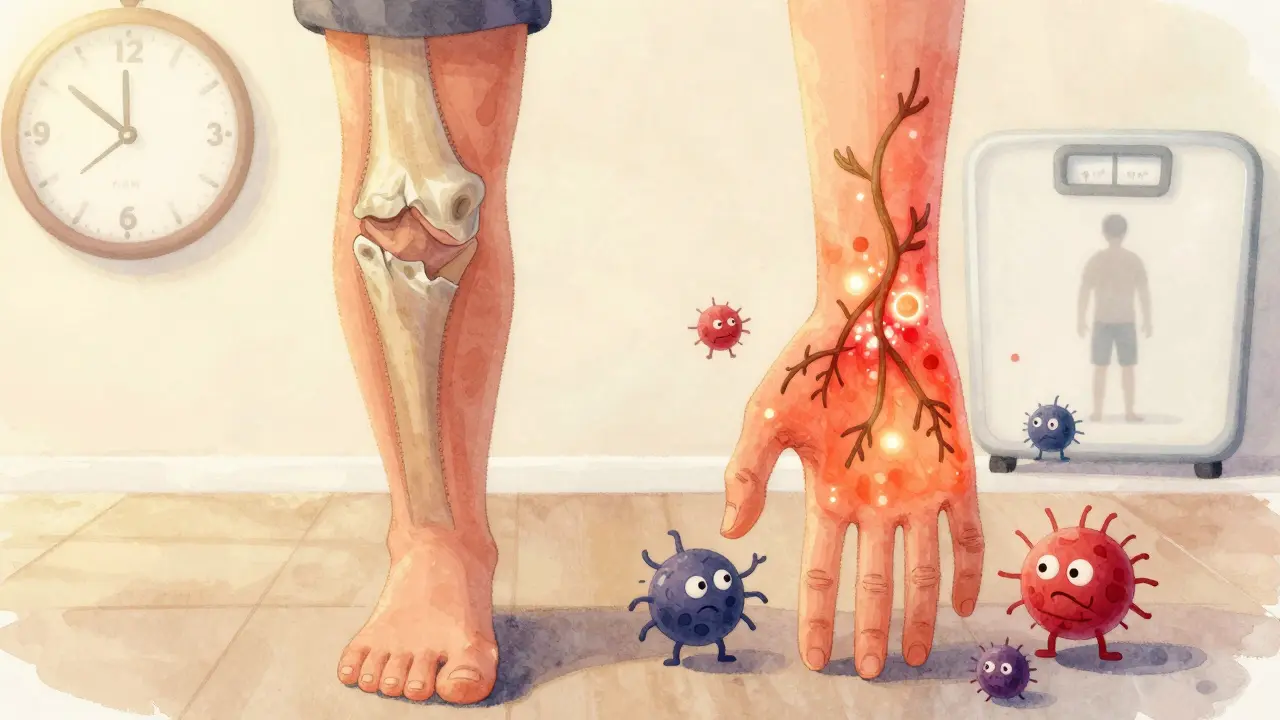
Over 50 million adults in the U.S. live with arthritis - and most of them don’t know exactly what type they have. It’s not just one disease. Arthritis is a group of more than 100 conditions, but two stand out: osteoarthritis and rheumatoid arthritis. They feel similar - stiff, aching joints - but they’re completely different in cause, progression, and treatment. Mixing them up can delay real help, sometimes permanently.
What Is Osteoarthritis? The Wear-and-Tear Type
Osteoarthritis (OA) is what happens when the cushioning between your bones breaks down. Think of it like the rubber on your shoe heels wearing thin after years of walking. This isn’t just aging - it’s mechanical stress. Carrying extra weight, past injuries, or repetitive motion can speed it up. You don’t need to be old to get it, but after 50, your risk climbs sharply.
It usually starts in one joint - often the knees, hips, lower back, or fingers. You might notice a grating feeling when you move, or small bony lumps near your knuckles. The pain comes when you use the joint, and it gets better with rest. Morning stiffness? It lasts less than 30 minutes. That’s a key clue.
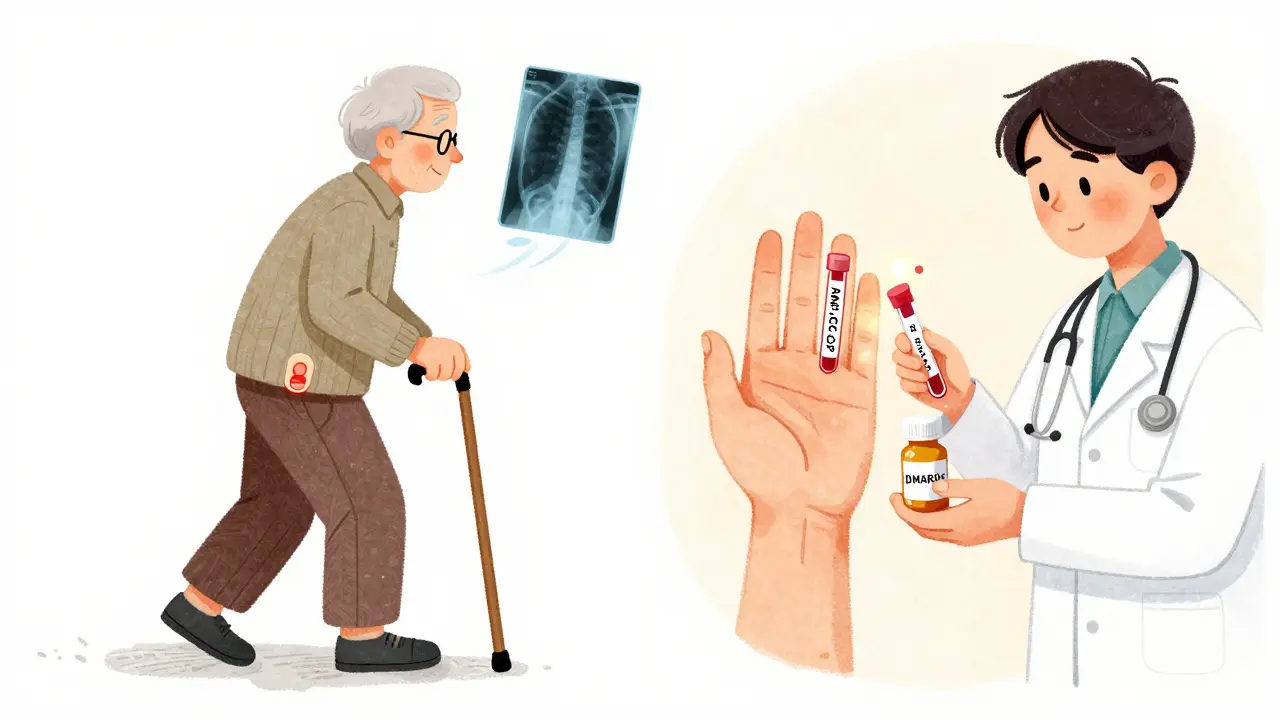
X-rays show it clearly: narrowed joint space, bone spurs, maybe even bone rubbing on bone. There’s no blood test for OA. Diagnosis is based on symptoms, physical exam, and imaging. Treatment? Focus on reducing pressure. Losing just 5 kilograms can cut knee pain in half. Physical therapy, NSAIDs like ibuprofen, and braces help. For severe cases, joint replacement is common - 90% of all knee and hip replacements in the U.S. are for OA.
What Is Rheumatoid Arthritis? The Body’s Betrayal
Rheumatoid arthritis (RA) isn’t about wear and tear. It’s an autoimmune disease. Your immune system, which should protect you, turns on your own joints. It attacks the synovium - the lining inside the joint - causing swelling, heat, and pain. This isn’t localized. RA can damage your lungs, heart, eyes, and even your skin.
Unlike OA, RA hits symmetrically. If your left wrist hurts, your right will too. It often starts in small joints - knuckles, wrists, fingers - but rarely the very tip of your fingers. Morning stiffness? It can last over an hour. You might feel exhausted, run a low fever, or lose weight without trying. These are systemic signs. OA doesn’t do that.
Doctors look for two key blood markers: rheumatoid factor (RF) and anti-CCP antibodies. These aren’t always positive, but when they are, they point strongly to RA. Ultrasound and MRI can show inflammation before X-rays show damage. Early diagnosis is critical. Left untreated, RA can destroy joints in months. That’s why treatment starts fast: DMARDs like methotrexate, biologics, or JAK inhibitors like tofacitinib. These drugs don’t just ease pain - they stop the immune system from attacking.
Key Differences at a Glance
Here’s how OA and RA really stack up:
| Feature | Osteoarthritis (OA) | Rheumatoid Arthritis (RA) |
|---|---|---|
| Primary Cause | Mechanical wear and tear on cartilage | Autoimmune attack on joint lining |
| Typical Onset Age | Over 50 | Any age, including teens and young adults |
| Joint Pattern | Asymmetrical - one knee, not both | Symmetrical - both hands, both wrists |
| Morning Stiffness | Less than 30 minutes | Over one hour |
| Systemic Symptoms | None | Fatigue, fever, weight loss, nodules under skin |
| Commonly Affected Joints | Knees, hips, spine, DIP finger joints | MCP joints, wrists, PIP joints - sparing DIP |
| Diagnostic Tools | X-ray, physical exam | Blood tests (RF, anti-CCP), ultrasound, MRI |
| Main Treatment | Weight loss, NSAIDs, physical therapy, joint replacement | DMARDs, biologics, JAK inhibitors - early aggressive therapy |
| Can It Be Reversed? | Progression can be slowed | Remission is possible with early treatment |
Other Common Types of Arthritis You Should Know
OA and RA are the big two, but they’re not the whole story.
Gout is sudden, fiery pain - often in the big toe. It’s caused by uric acid crystals building up. Attacks come out of nowhere, last days, then vanish. Diet (red meat, alcohol) and kidney function play a big role. Treatment involves anti-inflammatories and long-term meds to lower uric acid.
Psoriatic Arthritis shows up in people with psoriasis (that scaly skin condition). It can cause swollen fingers that look like sausages, and pain where tendons attach to bone. It’s also autoimmune. Treatments overlap with RA - biologics work well here too.
Ankylosing Spondylitis targets the spine and pelvis. It starts with lower back pain and stiffness, especially in the morning. Over time, it can fuse vertebrae. It’s linked to the HLA-B27 gene. Exercise and biologics are key.
Juvenile Idiopathic Arthritis (JIA) affects kids under 16. It’s not just growing pains. It can cause growth issues and eye inflammation. Early treatment with DMARDs or biologics can prevent lifelong damage.
Why Getting the Right Diagnosis Matters
Take two people with hand pain. One has OA - the cartilage between her knuckles is worn. The other has RA - her immune system is eating the joint lining. If the first person gets a biologic meant for RA? It won’t help. Worse - it could harm her. If the second person gets only ibuprofen and told to "just rest"? In six months, her hands could be permanently deformed.
RA doesn’t wait. The first 3 to 6 months after symptoms start are the window to prevent irreversible damage. That’s why specialists push for early blood tests and imaging. OA, on the other hand, responds to lifestyle changes. Lose weight, move more, strengthen muscles around the joint - and you can delay surgery by years.
Smoking raises your risk of RA by 2 to 3 times. Obesity increases OA risk 4.5 times for knee joints. These aren’t just risk factors - they’re modifiable. Quitting smoking doesn’t just help your lungs - it lowers your chance of developing RA. Losing weight doesn’t just make you feel better - it takes pressure off your knees and hips.

What’s New in Arthritis Care?
Diagnosis is getting faster. Ultrasound can now spot joint inflammation before X-rays show anything. Researchers are looking for blood biomarkers that signal cartilage breakdown in OA before it shows on scans.
Treatments are evolving. For RA, newer JAK inhibitors like tofacitinib offer oral options instead of injections. For OA, platelet-rich plasma (PRP) injections are being used more often, though evidence is still mixed. Some studies show they help with mild to moderate knee OA, but they’re not a cure.
And here’s something hopeful: RA used to be seen as always progressive. Now, with early treatment, 30% to 50% of patients reach remission. OA used to be seen as inevitable. Now we know that staying active, managing weight, and doing strength training can slow it down - even in people over 70.
What Should You Do If You Have Joint Pain?
Don’t assume it’s just aging. If your joint pain:
- Wakes you up at night
- Keeps you stiff for over an hour in the morning
- Affects both sides of your body
- Comes with fatigue, fever, or unexplained weight loss
- then see a doctor. Ask for blood tests. Don’t wait. If your pain is worse after activity, better with rest, and only on one side - it’s more likely OA. Still, get it checked. Early action changes outcomes.
For OA, start with movement. Low-impact exercise like swimming or cycling builds muscle around the joint. For RA, start with a rheumatologist. Don’t delay treatment. The clock is ticking.
Can you have both osteoarthritis and rheumatoid arthritis at the same time?
Yes. It’s not rare. Someone with RA might develop OA later from joint damage or aging. Or someone with OA from an old injury might also develop RA due to genetic or immune factors. Doctors look for overlapping symptoms - like symmetrical swelling in a joint already worn down by OA - and use blood tests and imaging to untangle the causes.
Is arthritis hereditary?
OA has a weak genetic link - if your parents had severe hand OA, you’re more likely to get it. RA has a stronger genetic component. Having the HLA-DRB1 gene increases your risk, but it doesn’t guarantee you’ll get it. Environment matters too - smoking, infection, and obesity can trigger RA in genetically prone people.
Can diet affect arthritis?
Diet doesn’t cause OA, but being overweight makes it worse. For RA and gout, food plays a bigger role. Omega-3s in fish may reduce inflammation. Sugar and processed foods can make RA symptoms worse. Gout flares are tied to red meat, shellfish, and alcohol - especially beer. There’s no magic diet, but eating whole foods and avoiding excess sugar helps everyone with joint pain.
Do joint supplements like glucosamine work?
For OA, some people report feeling better with glucosamine or chondroitin, but large studies show only small, if any, benefit. They’re safe for most, but they won’t repair cartilage or stop RA. Don’t rely on them as treatment. Focus on proven methods: exercise, weight control, and medical advice.
Can children get rheumatoid arthritis?
They don’t get RA - they get Juvenile Idiopathic Arthritis (JIA), which is similar but classified separately. JIA affects kids under 16 and can cause joint swelling, fever, and rashes. It’s also autoimmune. Early treatment with DMARDs or biologics can prevent growth problems and joint damage. Don’t dismiss childhood joint pain as "growing pains."
Next Steps: What to Do Today
If you’ve been ignoring joint pain, start here:
- Write down your symptoms: Which joints? When does it hurt? How long is morning stiffness?
- Track any other symptoms: fatigue, fever, skin changes, eye redness.
- See your doctor - ask for a referral to a rheumatologist if RA is suspected.
- If you’re overweight, start losing weight slowly. Even 5% of your body weight helps.
- Stop smoking. It’s one of the biggest preventable risks for RA.
Arthritis isn’t a death sentence. But it demands attention. Knowing the difference between OA and RA isn’t just academic - it’s the line between managing pain and preventing disability.




Jaspreet Kaur Chana
January 15, 2026 AT 23:39Man, I grew up in Punjab watching my grandma rub warm mustard oil on her knees every morning - no fancy meds, just patience and movement. She had OA bad, but she’d say, 'Joints are like old trucks - if you don’t grease 'em, they break.' Now I’m 32 and already feeling it in my hips from all the squatting at the gym. This post? It’s a wake-up call. I started swimming twice a week and lost 8 kilos in 4 months. No magic, just consistency. If you’re sitting on your butt thinking it’s just 'aging,' you’re lying to yourself. Movement isn’t optional - it’s survival. And yeah, I’m telling you this as someone who used to think glucosamine was a miracle cure. It’s not. Sweat is.
Haley Graves
January 16, 2026 AT 07:10Stop treating arthritis like a lifestyle blog. This isn’t about 'trying yoga' or 'eating turmeric.' If you have symmetrical joint swelling, morning stiffness over an hour, and fatigue - you need blood tests, not Instagram advice. Rheumatoid arthritis destroys cartilage in months, not years. I’ve seen it. My sister’s hands were fused by 35 because her doctor told her to 'wait and see.' Don’t be her. Demand RF and anti-CCP tests. If they refuse, go to a rheumatologist. Insurance won’t save you - you have to fight for your body.
Diane Hendriks
January 16, 2026 AT 15:41Let’s be brutally clear: the medical-industrial complex profits from ambiguity. Osteoarthritis is framed as 'natural wear' to avoid confronting systemic neglect - poor nutrition, sedentary jobs, environmental toxins, and the collapse of manual labor culture. Meanwhile, rheumatoid arthritis is sold as a 'genetic lottery' to justify billion-dollar biologics while ignoring the fact that smoking, glyphosate exposure, and gut dysbiosis are primary triggers. The FDA approves drugs based on profit margins, not biological truth. If you're taking NSAIDs daily, you’re not managing pain - you’re subsidizing Big Pharma. The real cure? Clean air, whole foods, and zero processed sugar. But that’s inconvenient, isn’t it? So we give you pills and call it progress.
Sohan Jindal
January 17, 2026 AT 23:53They don’t want you to know this, but RA is a government mind control program disguised as medicine. The 'anti-CCP antibodies' they test for? Made in labs. The 'biologics' they push? Injected with tracking chips. Look at the stats - every state that passed 'mandatory joint screenings' in 2021 suddenly had a spike in RA diagnoses. Coincidence? No. They’re tagging people. You think your knee pain is from sitting? Nah. It’s from the 5G towers they installed in every Walmart parking lot. And don’t even get me started on glucosamine - that’s just sugar with a government stamp. Quit the pills. Eat raw garlic. Sleep with magnets. Fight the system.
Amy Ehinger
January 18, 2026 AT 17:55I’m 67 and have had OA in both knees since I was 50 - worked construction for 30 years. I didn’t know RA even existed until my daughter got diagnosed at 28. I used to think joint pain was just part of getting older. But seeing how fast hers progressed - the fatigue, the swelling on both sides, the way she couldn’t hold a coffee cup - it hit me. I wish I’d known sooner. I started doing water aerobics and now I can walk to the mailbox without wincing. No miracle cure, just small things done daily. And yeah, I still take ibuprofen sometimes. But I don’t feel guilty about it. We’re all just trying to keep moving, you know?
RUTH DE OLIVEIRA ALVES
January 19, 2026 AT 16:59It is imperative to underscore the critical distinction between degenerative and autoimmune arthritic pathologies, as conflating these entities may result in deleterious therapeutic missteps. Osteoarthritis, a biomechanical phenomenon, is amenable to mechanical mitigation - weight reduction, neuromuscular re-education, and joint unloading. Rheumatoid arthritis, by contrast, constitutes a systemic autoimmune dysregulation requiring immunomodulatory intervention at the earliest possible juncture. Delay in initiating disease-modifying antirheumatic therapy is not merely suboptimal - it is iatrogenic. Furthermore, the assertion that 'diet can affect arthritis' must be contextualized: while dietary modification may attenuate inflammatory burden in seropositive RA and gout, it cannot reverse structural damage or replace pharmacologic intervention. Clinical vigilance, not anecdotal supplementation, remains the cornerstone of patient advocacy.
Crystel Ann
January 21, 2026 AT 11:00I just wanted to say thank you for writing this. My mom was told for years it was just 'old age' until she finally got tested and found out she had RA. She cried when she heard it wasn’t just 'wearing out' - she felt like someone finally saw her. Now she’s on methotrexate and can hold her grandkids again. I wish everyone knew how fast this can spiral. Don’t wait for the pain to be 'bad enough.' If your hands feel like they’re full of gravel in the morning, or your knees lock up after sitting - go get checked. You deserve to feel like yourself again.
Nat Young
January 23, 2026 AT 07:48Wow. So OA is just 'wear and tear' and RA is 'autoimmune'? That’s what they want you to believe. But here’s the real truth - OA is caused by glyphosate in your food. RA is caused by vaccines. Both are engineered by Big Pharma to sell you drugs. The 'bone spurs' on your X-ray? That’s your body trying to heal itself. The 'inflammation' they’re trying to suppress? That’s your immune system fighting back. You think they want you to move? To lose weight? To quit smoking? No. They want you on lifelong meds. The only cure is fasting and raw liver. I’ve been off all meds for 2 years. My joints are better than when I was 25. You’re being lied to.