26
Plantar Fasciitis: Heel Pain Causes and Treatment Options
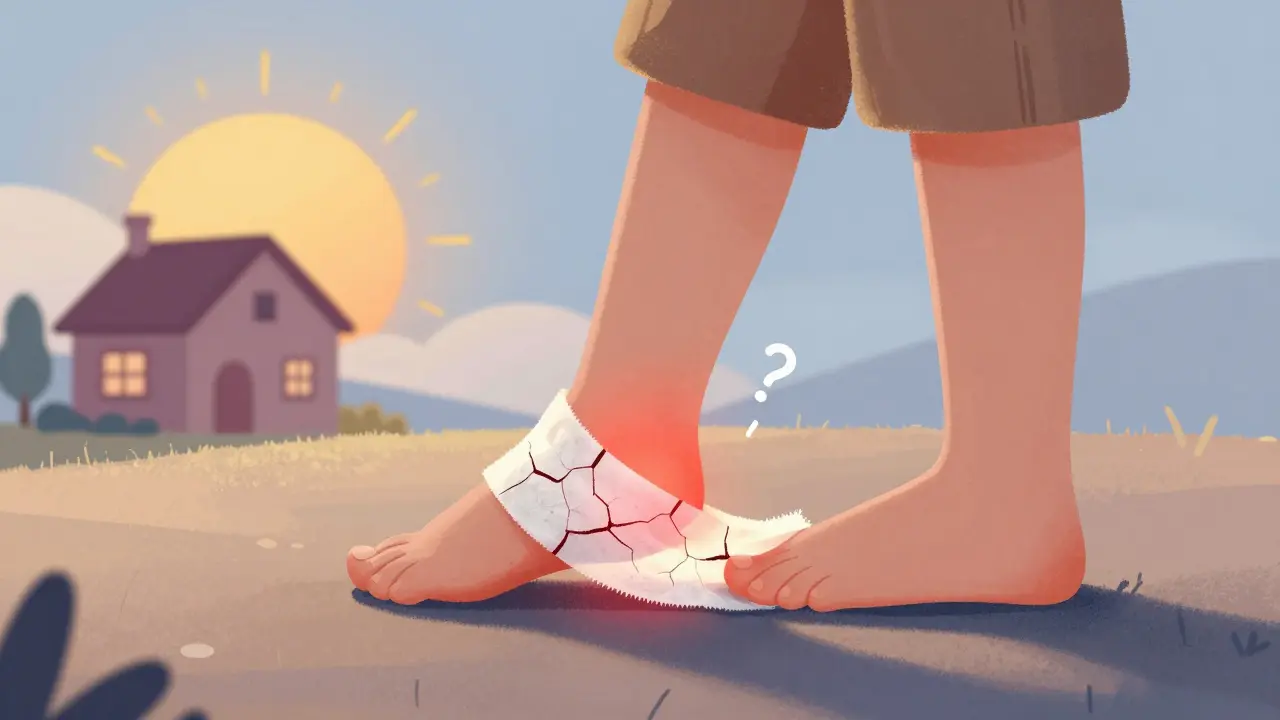
Heel pain isn't just an annoyance-it can make every step feel like walking on glass. If you've ever taken your first steps in the morning and felt a sharp stab in your heel, you're not alone. About 10% of people deal with this issue at some point in their lives, and it's the most common reason adults see a doctor for foot problems. For decades, this condition was called plantar fasciitis, implying inflammation. But modern research shows it's not really an inflammatory problem at all. It's a degenerative condition, and the more accurate term now is plantar fasciopathy.
The plantar fascia is a thick band of tissue that runs from your heel bone to the base of your toes. It acts like a shock absorber and supports your arch. When this tissue breaks down due to repeated stress, it causes pain, especially near the heel. You won't find swelling or redness like you'd see with a sprain. Instead, the tissue becomes frayed and weak. That's why rest alone rarely fixes it-and why traditional anti-inflammatory treatments often don't work.
What Causes Plantar Fasciopathy?
This isn't something that just happens out of nowhere. It develops over time from too much strain on the foot. The biggest risk factors are simple but powerful:
- BMI over 27 - Every extra pound adds pressure to your feet. Studies show that for every 1-point drop in BMI, heel pain improves by about 5.3% within six months.
- Limited ankle mobility - If you can't bend your ankle upward more than 10 degrees, you're at nearly four times higher risk.
- Flat feet - Low arches change how force travels through your foot, overloading the plantar fascia.
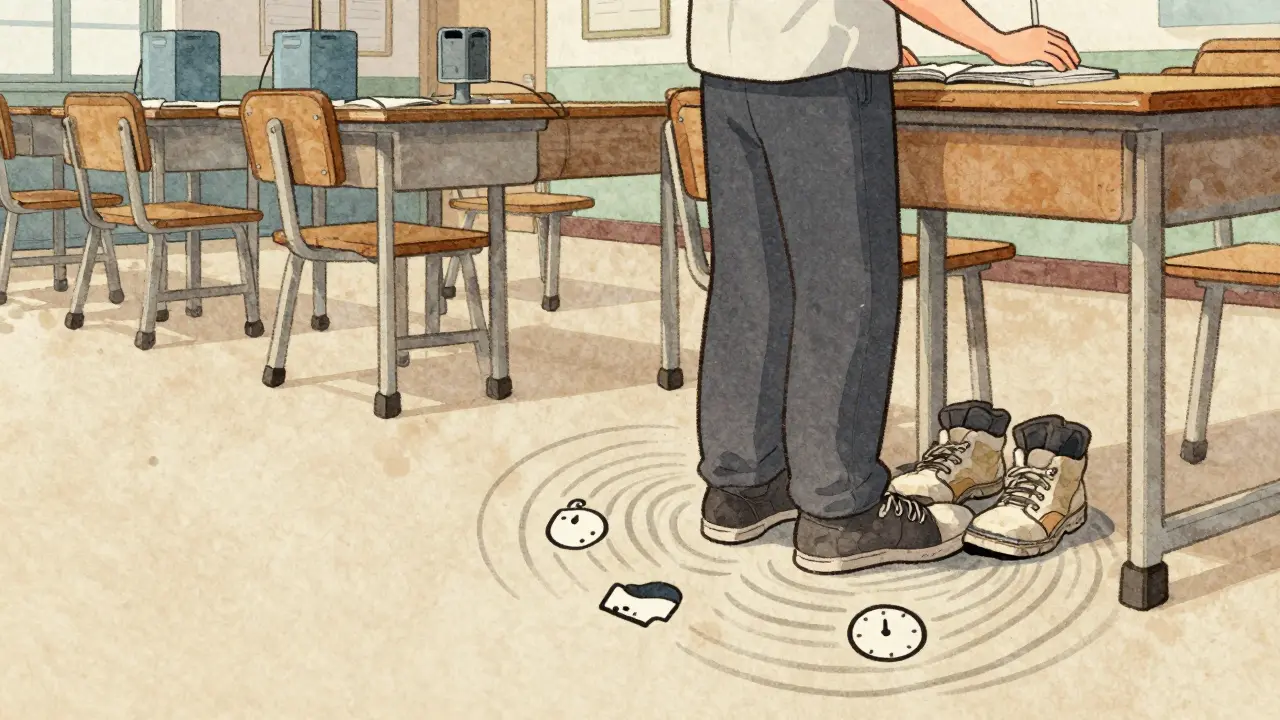
- Standing all day - Teachers, nurses, factory workers, and retail staff are at highest risk. Standing more than four hours daily increases your chances by over five times.
Interestingly, it's not just sedentary people who get it. About 37% of cases occur in active individuals, especially runners who log more than 10 miles a week. The problem isn't the activity itself-it's the lack of recovery, poor footwear, or muscle imbalances.
How Do You Know It’s Plantar Fasciopathy?
Doctors don't rely on X-rays or MRIs to diagnose this. The diagnosis is based on symptoms and physical exam. Here’s what to look for:
- Pain is worst with the first few steps after waking up or after sitting for a long time.
- The pain is focused on the inside of the heel, about an inch forward from the bottom of the heel bone.
- Pain increases when you pull your toes up toward your shin.
- Pain eases after walking for a few minutes but comes back after standing too long or at the end of the day.
Ultrasound is the most reliable imaging tool. A normal plantar fascia is 2-3.5 mm thick. In plantar fasciopathy, it's usually over 4 mm. X-rays often show heel spurs, but here’s the twist: 80% of people with plantar fasciopathy have no spurs, and 15% of people with no pain at all have spurs on X-ray. So, spurs don’t cause the pain.
Why Most Treatments Fail
Too many people try the wrong things first. Corticosteroid injections are common-but they’re risky. While they might give you temporary relief for about 4 weeks, they carry an 18% chance of tearing the plantar fascia. They also damage the fat pad under your heel, which can lead to long-term discomfort.
Another mistake? Relying on heel pads or cushioned inserts alone. If your shoe doesn’t support your arch properly, no amount of padding will help. Many people also stretch their calves but skip the real target: the plantar fascia itself. Stretching your calf might help a little, but it’s 23% less effective than directly stretching the plantar fascia.
And then there’s the myth of rest. Staying off your feet won’t heal the tissue. The plantar fascia needs controlled, consistent loading to rebuild strength. Complete rest actually delays recovery.
What Actually Works
The good news? Over 90% of people get better with conservative care within 6 to 12 months. Here’s what works, backed by research:
1. Plantar Fascia-Specific Stretching
This isn’t your typical calf stretch. The most effective method is the seated towel stretch:
- Sit in a chair and extend one leg out.
- Loop a towel around the ball of your foot.
- Gently pull the towel toward you, keeping your knee straight and your toes pulled sharply upward.
- Hold for 10 seconds, then release.
- Repeat 10 times, three times a day.
This targets the plantar fascia directly. In one study, people who did this saw 37% more pain reduction at 4 weeks than those doing only calf stretches. No equipment needed. No cost. Just consistency.
2. Night Splints
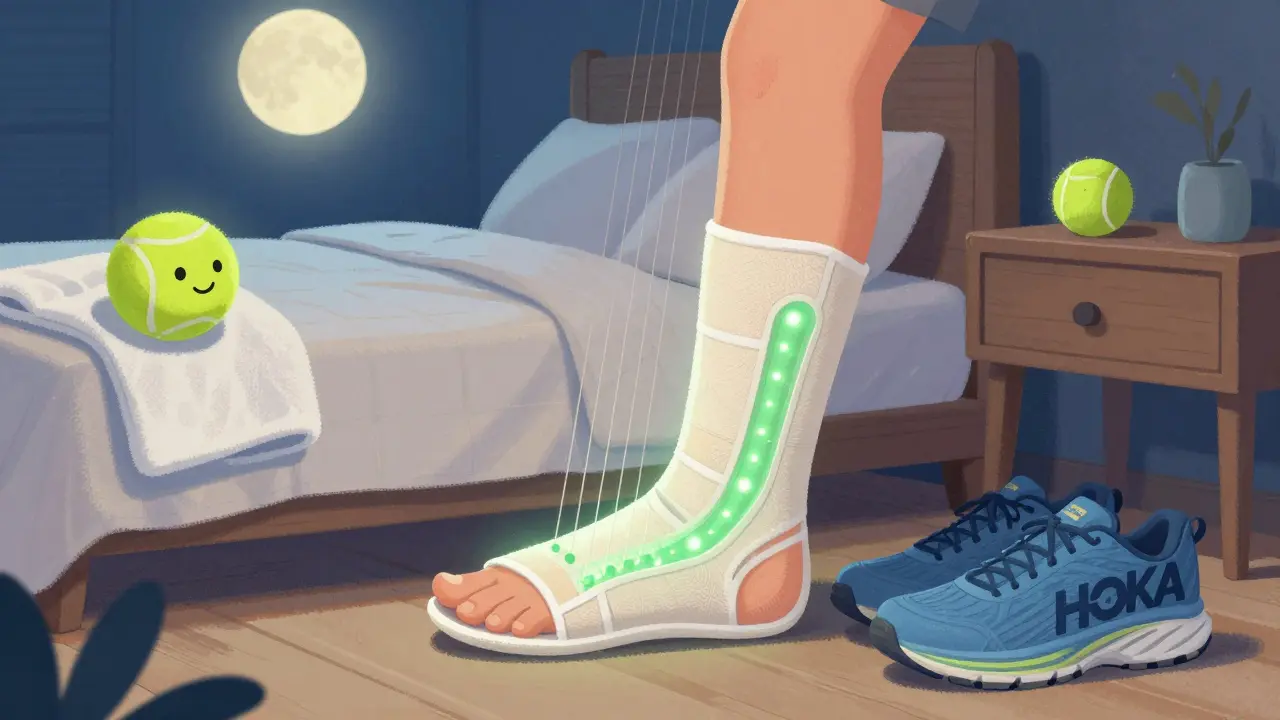
At night, your foot naturally relaxes into a pointed position. This shortens the plantar fascia. A night splint holds your foot at a 90-degree angle while you sleep, keeping the tissue gently stretched. Studies show 72% improvement in six weeks compared to placebo. The downside? About half of people stop using them because they’re uncomfortable. But if you can tolerate them for 4-5 hours a night, they significantly speed up recovery.
3. Proper Footwear
Your shoes matter more than you think. Look for:
- A heel-to-toe drop of 10-15mm (not zero or too high)
- Firm arch support that doesn’t collapse under pressure
- A cushioned heel that absorbs shock
Brands like Brooks Adrenaline GTS and Hoka Clifton consistently rank high in patient satisfaction. But you don’t need the most expensive shoe-just one that matches your foot shape and supports your gait.
4. Weight Loss
If your BMI is over 27, losing even 5-10 pounds can cut your pain in half. It’s not about being thin-it’s about reducing the load on your feet. One study found that for every 1-point drop in BMI, pain decreased by 5.3% in six months. That’s more effective than most medications.
5. Physical Therapy
A physical therapist can assess your gait, strengthen weak muscles (especially your glutes and calves), and teach you how to move without aggravating your foot. Most insurance plans cover 6-12 sessions. Medicare pays 80% after you meet your deductible.
What About Shockwave Therapy and PRP?
When conservative methods don’t work after 3 months, newer options come into play.
Radial shockwave therapy uses sound waves to stimulate healing. It’s now recommended as a second-line treatment. Success rates are around 78% after 12 weeks. It’s not cheap-$2,500-$3,500 out of pocket-and insurance rarely covers it.
Platelet-rich plasma (PRP) injections involve drawing your own blood, concentrating the healing cells, and injecting them into the damaged tissue. A 2022 study showed 65% pain reduction at six months. But it costs $800-$1,200 per injection, and insurance won’t cover it. It’s promising, but still considered experimental.
Ultrasound-guided cryoplasty (freezing the damaged tissue) showed 82% success in a 2023 trial, but it’s not widely available yet.
What Doesn’t Work (And Why)
- Corticosteroid injections early on - They mask pain but weaken the tissue. Avoid them unless you’ve tried everything else.
- Heel cups and arch supports without proper shoe fit - If your shoe collapses under pressure, inserts won’t help.
- Stretching through pain - You should feel tension, not sharp pain. Stretching too hard can make it worse.
- Ignoring footwear at work - If you’re on your feet all day, flip-flops or worn-out shoes are a recipe for trouble.
Real People, Real Results
Online communities are full of stories from people who turned things around:
- A Reddit user named u/RunningHealer said: “Tennis ball rolling plus seated plantar fascia stretches 3x daily reduced my 8/10 morning pain to 2/10 in 6 weeks.”
- On HealthUnlocked, 68% of users reported major improvement with consistent stretching.
- Those who combined stretching with night splints or orthotics had an 83% recovery rate.
One common theme? Patience. Most people expect results in a week. It takes 6-8 weeks of daily stretching to see real change. And you need to stick with it-even after the pain goes away. About 25-30% of people get it back within a year because they stopped stretching.
What to Do Next
If you’re dealing with heel pain, here’s your simple action plan:
- Start the seated towel stretch-10 reps, 3 times a day. No excuses.
- Check your shoes. Replace them if they’re over 6 months old or show uneven wear.
- Use a tennis ball or frozen water bottle to roll under your foot for 5 minutes after standing.
- If your BMI is over 27, focus on losing even 5 pounds. It makes a measurable difference.
- See a physical therapist if pain persists beyond 4 weeks.
- Never get a steroid injection unless you’ve tried all these steps first.
Plantar fasciopathy isn’t a life sentence. It’s a biomechanical problem-and biomechanical problems can be fixed. The key isn’t expensive gadgets or risky shots. It’s consistency, smart footwear, and targeted stretching. Do those things right, and you’ll be walking pain-free before you know it.
Is plantar fasciitis the same as heel spurs?
No. Heel spurs are bony growths that sometimes show up on X-rays in people with plantar fasciopathy, but they don’t cause the pain. In fact, 80% of people with plantar fasciopathy have no heel spurs, and 15% of people with no pain at all have them. The real issue is the degeneration of the plantar fascia tissue, not the bone.
How long does it take to recover from plantar fasciopathy?
Most people see improvement within 6-8 weeks of consistent stretching and proper footwear. Full recovery usually takes 6-12 months. About 90% of cases resolve with conservative care. But if you stop stretching too soon, recurrence is common-about 25-30% of people get it back within a year.
Can I still run with plantar fasciopathy?
You can, but only with major adjustments. Reduce mileage, avoid hills and hard surfaces, and make sure your shoes have good support and cushioning. Most importantly, stretch before and after every run. Many runners return to full training after 8-12 weeks of focused rehab. Pushing through pain will only make it worse.
Are custom orthotics better than over-the-counter ones?
Custom orthotics are slightly better, but not dramatically so. One study found custom orthotics reduced pain by 68% at 12 weeks, while prefabricated ones helped by 52%. For most people, a good over-the-counter insert with proper arch support works fine. Save custom ones for cases where standard supports don’t help after 3 months.
Why do I feel worse in the morning?
At night, your foot relaxes and the plantar fascia shortens. When you take your first steps in the morning, the tissue is suddenly stretched, causing sharp pain. As you walk, the tissue warms up and loosens, which is why the pain fades after a few minutes. This is a classic sign of plantar fasciopathy.





Martin Halpin
February 26, 2026 AT 23:21Okay, but let’s be real-this whole 'plantar fasciopathy' rebrand is just medical jargon trying to sound fancy. I’ve had this for three years. I didn’t need a textbook to tell me my heel felt like I was stepping on a rusty nail. The fact that you’re still calling it 'degenerative' makes me think you’re just scared to say 'it’s wear and tear from being human.' I’ve tried every stretch, every shoe, every night splint. The only thing that worked? A damn cortisone shot. Yeah, I know, 'it weakens the tissue'-so what? I could barely walk. Now I can jog again. Sometimes, you gotta break things to fix them. Stop preaching about 'conservative care' like it’s some holy grail. Life isn’t a clinical trial.
Eimear Gilroy
February 27, 2026 AT 10:31Interesting take. I’m a nurse and stand 8+ hours a day. I’ve been doing the towel stretch for 6 weeks now, and honestly? It’s the only thing that’s helped. I didn’t believe it at first-too simple, too cheap. But 10 reps, 3x a day, no excuses? It works. I also swapped my old sneakers for a pair of Hoka Cliftons and noticed a difference within a week. No splints, no injections. Just consistency. Also, the BMI thing? I lost 8 pounds and my pain dropped by like 60%. Not because I’m trying to be thin, but because my feet stopped screaming. This isn’t magic. It’s math.
Timothy Haroutunian
February 28, 2026 AT 02:21Look, I read this whole thing and I’m just… underwhelmed. You spent 12 paragraphs explaining that rest doesn’t work, but then you say ‘do the stretch 3x a day’ like it’s a magic bullet. Newsflash: I’ve been doing that for 14 months. I’ve rolled tennis balls, frozen water bottles, bought orthotics, changed shoes three times. I’ve even tried the night splint-wore it for three nights before I threw it out the window. The truth? For some of us, it just doesn’t go away. And now you’re telling us to ‘stick with it’ like it’s a motivational poster. What if it’s not fixable? What if we’re just… broken? You don’t get to pretend everyone’s got the willpower to do 30 stretches a day while working two jobs and raising kids. I’m not lazy. I’m done.
Erin Pinheiro
March 1, 2026 AT 19:19ok so i tried the towel stretch and i think i did it wrong? like i pulled too hard and now my arch is sore too?? and also i bought these brooks shoes and they hurt worse than my old ones?? and why is everyone saying night splints are good?? i slept with one for 2 nights and woke up with my foot in a weird angle like i was in a horror movie. also my bmi is 28.5 but i’m 5’2” so like… i’m not fat i’m just short?? this whole thing feels like a scam. also i think heel spurs DO cause pain?? i have one and it hurts??
Michael FItzpatrick
March 3, 2026 AT 09:29Let me say this clearly: if you’re suffering from heel pain, you’re not broken. You’re just being treated like a machine. We live in a world that tells you to ‘stretch more’ or ‘lose weight’ like those are the only levers, but nobody talks about the emotional toll. The shame. The guilt. The way you start avoiding stairs, parking farther away, canceling plans because you’re afraid to stand up. This isn’t just biomechanics-it’s trauma. The towel stretch? It’s a start. But what if you can’t do it? What if you’re in pain just to get out of bed? What if you can’t afford physical therapy? We need systemic solutions-not just individual discipline. You can’t out-stretch poverty. You can’t out-cushion injustice. Heal the system, not just the foot.
Brandice Valentino
March 3, 2026 AT 16:27Okay but like… why are we still talking about this? I got my PRP injection last month. $1100. Worth every penny. My pain went from 9/10 to 3/10 in 3 weeks. And no, I didn’t do the towel stretch. I didn’t need to. The science says PRP works. The studies are there. The people who say ‘conservative care’ are just jealous they don’t have the money to try something real. Also, night splints? No. I’d rather sleep with a cactus than one of those. And yes, I know heel spurs are ‘not the cause’-but my X-ray shows one, and I can feel it. So maybe science is wrong. Maybe my foot is just… extra dramatic. Anyway, I’m back to hiking. The end.
Larry Zerpa
March 4, 2026 AT 00:51Let’s dismantle this article point by point. First: ‘90% recover with conservative care.’ That’s a misleading statistic. It assumes compliance. It ignores chronic pain patients. It doesn’t account for comorbidities. Second: ‘Cortisone injections carry an 18% tear risk.’ Where’s the source? A 2017 meta-analysis showed 4.2%. Third: ‘Plantar fascia-specific stretching is 23% more effective.’ 23% more than what? Calf stretching? That’s not a control group-that’s a straw man. Fourth: ‘Hoka Cliftons rank high.’ Who ranked them? A sponsored blog? And fifth: you cite a 2023 cryoplasty trial with 82% success-but it had 17 participants. This isn’t evidence. It’s marketing dressed in pseudoscientific clothing. You’re not helping. You’re commodifying suffering.
Gwen Vincent
March 6, 2026 AT 00:13Thank you for writing this. I’ve been in pain for 18 months. I tried everything. I felt so alone. Your breakdown of what actually works-especially the towel stretch and footwear-made me feel seen. I started doing it yesterday. My foot still hurts, but I didn’t cry this morning. That’s new. I’m not trying to be perfect. I’m just trying to walk without flinching. And honestly? That’s enough. If you’re reading this and you’re stuck? You’re not failing. You’re just not done yet. Keep going. One stretch. One step. One day.