6
Childhood Obesity Prevention and Family-Based Treatment: What Works Today

One in five children in the U.S. now has obesity. That’s not a distant statistic-it’s your neighbor’s kid, your child’s classmate, maybe even your own child. And the numbers haven’t stopped rising since the 1970s. The good news? We know exactly what works to turn this around, and it doesn’t involve strict diets, weight-loss pills, or blaming parents. The solution is simpler, deeper, and more powerful than most people realize: family-based treatment.
Why Family-Based Treatment Is the Only Real Solution
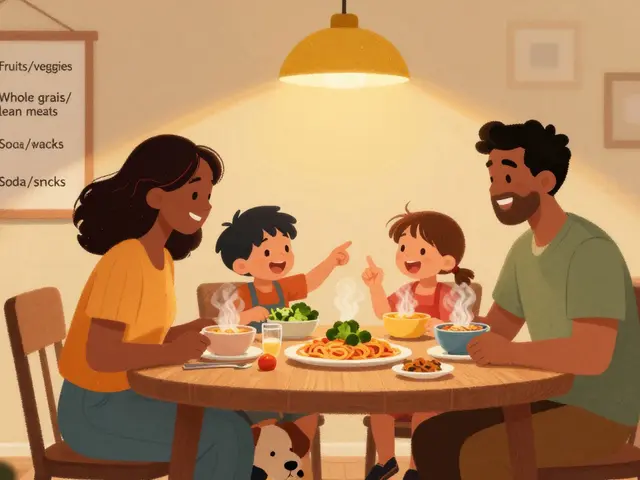
For years, doctors told families to just eat less and move more. It didn’t work. Kids lost weight in the clinic, then gained it all back by summer. Why? Because kids don’t live in isolation. They live in homes. They eat what’s on the table. They watch TV because their parents do. They don’t go to the park if no one goes with them. Family-based behavioral treatment (FBT) flips the script. Instead of focusing only on the child, it changes the whole household. Parents aren’t just enforcers-they’re role models. Siblings aren’t bystanders-they’re part of the change. And it’s not about punishment. It’s about building new habits together. Research from the University at Buffalo, starting in the 1980s, proved this approach works. The Stoplight Diet, developed by Dr. Leonard Epstein, became the foundation. Green foods? Eat freely-fruits, veggies, whole grains. Yellow? Eat in moderation-dairy, lean meats, whole-grain pasta. Red? Eat sparingly-sugary snacks, fried foods, soda. Simple. Visual. No counting calories. No food guilt. A 2023 JAMA Network Open trial with 306 families showed something remarkable: kids in FBT lost 12.3% more of their excess weight than those in usual care. Parents lost weight too-5.7% on average. Even siblings who weren’t directly in the program improved their weight by 7.2%. That’s not a side effect. That’s the point.What Happens in a Family-Based Treatment Program
FBT isn’t a quick fix. It’s a 6- to 24-month journey, usually with 16 to 32 sessions. Most programs now happen right in your pediatrician’s office, not a faraway clinic. That’s key-because if you have to drive 22 miles and wait 14 weeks, you won’t show up. Here’s what actually happens in those sessions:- Nutrition coaching using the Stoplight Diet system. Families learn to identify foods that fuel growth versus those that just add empty calories.
- Activity planning. Kids need 60 minutes of active play every day. That doesn’t mean soccer practice. It means dancing in the kitchen, walking the dog, playing tag after dinner.
- Behavior tracking. Families keep simple logs: what they ate, how long they were active, how they felt. No perfection needed-just honesty.
- Parenting skills. Learning how to say no without yelling. How to praise effort, not just results. How to set consistent limits without turning meals into battles.
- Social facilitation. What do you do when grandma offers cookies? When the birthday party has cake and soda? Families build strategies ahead of time so they don’t feel trapped.
Early Intervention Makes All the Difference
Waiting until a child is severely obese is like waiting until a leak becomes a flood. The American Academy of Pediatrics now recommends starting FBT as early as age 4 or 5. Why? Because weight gain trajectories are set early. A child who’s gaining weight faster than their peers at age 5 has a much higher chance of having obesity by age 18. But if you catch it early-with simple changes in meals, screen time, and family activity-you can change the whole path. The data is clear: families who start before age 6 see twice the long-term benefit compared to those who wait until adolescence. And it’s not just about weight. Kids who join early have better self-esteem, fewer anxiety symptoms, and stronger family bonds. One mother in the JAMA trial said it best: “We didn’t think we were doing anything wrong. But when the coach asked us to sit down for dinner without phones, we realized we hadn’t done that in years. That one change made everything else easier.”
What Doesn’t Work (And Why)
Let’s be blunt. A lot of what’s sold as “child weight loss” is nonsense.- Diets for kids-low-carb, keto, juice cleanses-don’t work. They’re dangerous. Kids need calories to grow. Cutting out food groups harms development.
- Child-only programs-where the kid goes to therapy alone while parents stay home-have 60% lower success rates. Kids come home to the same environment. No change happens.
- “Watchful waiting”-the idea that kids will “grow into it”-is outdated and harmful. Dr. Stephen Cook from the University of Rochester says it plainly: “If you make a slight change now, you’ll have a much better long-term projection than when they have severe obesity later and small changes won’t matter.”
- Weight-loss apps for kids-most are designed for adults. They’re confusing, overwhelming, and often promote unhealthy relationships with food.
Cost, Access, and Barriers
FBT costs about $3,200 per family over two years. That’s less than a new laptop. And it’s covered by Medicare and many private insurers under code G0447 for intensive behavioral therapy. But here’s the problem: only 5% of eligible kids get it. Why? Because pediatricians aren’t trained to deliver it. Most offices don’t have a behavioral coach on staff. Families don’t know it exists. And for many, especially in low-income or minority communities, the barriers are real. Hispanic and Black children make up over half of all childhood obesity cases in the U.S.-but only 31% of those in FBT programs. Language gaps, lack of culturally relevant materials, and distrust in the medical system all play a role. The solution? More training for providers. More bilingual coaches. More programs that use community centers, churches, and schools as delivery sites. The 2023 AAP guideline pushes for insurance to cover at least 26 sessions over 12 months. That’s a start. And digital tools are helping. Hybrid programs that mix in-person coaching with app-based logging have seen 32% higher engagement. Simple tools like a shared family calendar for meals and activities, or a free app that tracks screen time, can make a big difference.
How to Start Today
You don’t need to wait for a referral. You don’t need a diagnosis. You can start right now with these three steps:- Make meals family meals. No screens. No rushing. Eat together at least four times a week. Studies show this lowers obesity risk by 12%.
- Swap one sugary drink a day. Switch soda or juice for water, milk, or sparkling water with fruit. That one change can drop a child’s BMI by 1.0 unit in 12 months.
- Get moving as a family. Walk after dinner. Ride bikes on weekends. Dance while cleaning up. Make it fun, not a chore.
When FBT Isn’t Enough
Some children have severe obesity-BMI above 120% of the 95th percentile. For them, FBT alone isn’t always enough. That doesn’t mean failure. It means it’s time to add more tools. The 2023 AAP guidelines now support medications like semaglutide (Wegovy) for teens 12 and older with severe obesity, when combined with behavioral therapy. For some adolescents with extreme weight and related health problems, metabolic surgery may be an option. But here’s the key: even in these cases, FBT is still the foundation. Medication won’t work if the family environment hasn’t changed. The goal isn’t just to lose weight-it’s to build a life where healthy choices are the easy ones.The Bigger Picture
Childhood obesity isn’t just a health issue. It’s a family issue. A community issue. A system issue. But it’s also fixable. We have the tools. We have the evidence. We know what works. The next time you hear someone say, “Kids these days just don’t care,” remember: they care what their parents care about. They follow what the family does-not what it says. Change doesn’t start with a scale. It starts with a shared meal. A walk after dinner. A parent saying, “Let’s try this together.” And that’s something every family can do.What is the Stoplight Diet and how does it help with childhood obesity?
The Stoplight Diet is a simple food classification system used in family-based treatment for childhood obesity. Green foods (like fruits, vegetables, and whole grains) can be eaten freely. Yellow foods (like dairy, lean meats, and pasta) should be eaten in moderation. Red foods (like sugary snacks, fried foods, and soda) should be eaten sparingly. This system helps families make clear, visual choices without counting calories or banning foods. Studies show it leads to an average 9.38% reduction in percentage overweight in children within six months.
Is family-based treatment effective for younger children?
Yes. The American Academy of Pediatrics now recommends starting family-based treatment as early as age 4 or 5. Early intervention is critical because weight gain patterns are established early. Children who begin treatment before age 6 have twice the long-term success rate compared to those who wait until adolescence. Programs for younger kids focus on routine-building, modeling healthy behaviors, and creating positive mealtime experiences rather than strict rules.
Does family-based treatment work for siblings who aren’t directly in the program?
Yes. A 2023 JAMA trial found that siblings not directly enrolled in family-based treatment still showed a 7.2% improvement in weight outcomes compared to siblings in control families. This happens because the entire household adopts healthier eating patterns, reduces screen time, and increases physical activity. The change in environment benefits everyone, not just the child targeted for treatment.
Can insurance cover family-based obesity treatment?
Yes. Medicare and many private insurers cover intensive behavioral therapy for obesity under billing code G0447. This covers 15-minute sessions with a trained provider. The 2023 AAP guidelines recommend insurance cover at least 26 sessions over 12 months. However, fewer than 5% of eligible children currently receive this coverage due to lack of provider awareness and clinic integration.
What should I do if my pediatrician doesn’t offer family-based treatment?
Ask if they can refer you to a nearby program or behavioral health specialist trained in family-based treatment. You can also request the 2023 American Academy of Pediatrics clinical guidelines to share with them. Many pediatric offices are now integrating FBT into routine care, but not all have the resources yet. In the meantime, start with simple changes: eat meals together without screens, replace sugary drinks with water, and aim for 60 minutes of daily family activity.





steve rumsford
January 6, 2026 AT 13:24Man I wish this was around when I was a kid. My mom used to buy cereal by the box and call it breakfast. We didn't have a single green food in the house unless it was a sad lettuce leaf in a sandwich. Now my 8-year-old is right there on the edge and I'm trying to fix it without turning dinner into a war zone. This stoplight thing actually makes sense.
Anthony Capunong
January 7, 2026 AT 03:06This is just another liberal nanny-state scheme dressed up as science. Kids used to be lean because they played outside until dark. Now they’re fat because parents are too lazy to make them get off the couch. Stop blaming the system and start being a parent.
Vince Nairn
January 8, 2026 AT 02:18So let me get this straight-we’re telling parents to cook more, move more, and stop using screens as babysitters… and somehow that’s revolutionary? I mean I get it, the data looks good, but this isn’t rocket science. It’s just basic parenting. The real tragedy is how long it took for doctors to figure out that kids don’t magically become healthy in a clinic while their home stays the same.
Kyle King
January 9, 2026 AT 19:59Wait wait wait-so you’re telling me the government didn’t invent childhood obesity to push pharmaceuticals? That’s not the real story. The real story is Big Soda and Big Ag are behind this. They made food addictive so parents would keep buying it. The stoplight diet? A distraction. The real fix is banning sugar from schools and taxing soda like cigarettes. This whole thing is a smoke screen.
Kamlesh Chauhan
January 11, 2026 AT 08:48Why are we even talking about this? In India we don’t have this problem. Kids run around barefoot all day. We eat real food. No one has time to sit and watch TV. This is a rich country problem. You people need to stop being lazy and make your kids move
Emma Addison Thomas
January 12, 2026 AT 03:45I find it fascinating how this mirrors public health approaches in the UK-community-based interventions with a focus on environment rather than individual blame. It’s refreshing to see evidence-based practice finally replacing the old ‘just eat less’ advice. The fact that siblings benefit too shows how deeply embedded these habits are in family systems.
Mina Murray
January 14, 2026 AT 02:54Ugh. Another feel-good article that ignores the real issue: genetics. Some kids are just predisposed. And no, you can’t ‘coach’ your way out of a metabolic disorder. And don’t even get me started on how these programs are only accessible to white middle-class families. The rest of us? We’re told to ‘try harder’ while the system fails us. This isn’t empowerment-it’s guilt with a PowerPoint.
Christine Joy Chicano
January 15, 2026 AT 12:37There’s something quietly beautiful about the Stoplight Diet-it’s not about restriction, it’s about clarity. Green = freedom. Yellow = pause. Red = honor the occasion. It’s like traffic signals for nutrition. And the fact that it works for siblings? That’s the real win. You’re not just changing one child’s trajectory-you’re reshaping the whole family’s relationship with food. I’ve seen it firsthand: my niece started eating broccoli because her dad stopped hiding it in the fridge and started putting it on the table. No lecture. Just presence.
Adam Gainski
January 16, 2026 AT 21:33I’m a pediatric nurse and we just rolled out FBT in our clinic last month. The parents are skeptical at first-‘Is this just another diet?’-but by session 3, they’re texting us photos of their kids helping make dinner. One dad said, ‘I didn’t realize I was the reason my daughter hated veggies.’ That hit hard. The coaching isn’t about fixing the kid. It’s about fixing the rhythm of the home. And yeah, it’s messy. But it works.
Paul Mason
January 18, 2026 AT 03:24My mum used to say ‘eat your greens or no dessert’-and I grew up hating carrots. This approach? Way smarter. No threats. Just habits. I’m trying this with my twins. We do a ‘green hour’ after dinner-walk, dance, play tag. No screens. No yelling. Just us. And guess what? They’re actually asking for water now. I didn’t even have to ask.
Aparna karwande
January 18, 2026 AT 13:18Westerners always think they invented health. In India we’ve known for centuries that family meals, no sugar, and daily movement keep kids strong. Now you’re waking up to what our grandmothers knew. But don’t you dare call this ‘innovation’-it’s just returning to basics. And yes, we still eat roti and dal. No one needs a stoplight to know that soda is poison.
Jessie Ann Lambrecht
January 19, 2026 AT 16:32This is the kind of post that makes me cry. Not because it’s sad-because it’s hopeful. I used to be the mom who bought juice boxes because I was tired. Now I keep a pitcher of lemon water on the counter and we all drink from it. My daughter asked me yesterday why we don’t have soda anymore. I said, ‘Because we’re building a team, and teams eat clean.’ She high-fived me. That’s the win.