13
Pregnancy and Liver Disease: Understanding Cholestasis and Safe Treatment Options

What Is Cholestasis in Pregnancy?
Cholestasis in pregnancy, also known as intrahepatic cholestasis of pregnancy (ICP), is a liver condition that happens only during pregnancy. It doesn’t mean your liver is broken - it just means bile isn’t flowing the way it should. Bile is a fluid your liver makes to help digest food. Normally, it flows out of the liver through tiny tubes called bile ducts and into the intestines. But in ICP, pregnancy hormones slow or block that flow. That causes bile acids to build up in your blood.
This isn’t just about discomfort. High bile acid levels can cross the placenta and affect your baby. The main symptom is intense itching, usually on the palms of your hands and soles of your feet. It gets worse at night and doesn’t come with a rash. Many women mistake it for dry skin or a normal pregnancy itch. But if the itching is severe, constant, and doesn’t go away with lotion, it could be ICP.
How Common Is It?
ICP affects about 1 to 2 out of every 1,000 pregnancies in the U.S. But that number changes a lot depending on where you live and your background. In Chile, it’s as high as 1 in 6 pregnancies. Among Latina women in the U.S., the rate is around 5.6%. In the U.K., it’s closer to 1%. If you’ve had ICP in a past pregnancy, you have a 60-70% chance of getting it again. If your mom or sister had it, your risk goes up 12 to 15 times.
Multiple pregnancies - like twins or triplets - also raise your risk by 3 to 5 times. Women who got pregnant through IVF are twice as likely to develop ICP. Even if you don’t have a family history, if you’re carrying more than one baby, your doctor should be watching closely.
How Do Doctors Diagnose It?
There’s no single test that confirms ICP just by looking at you. The itching alone isn’t enough. Doctors need to measure bile acid levels in your blood. The standard cutoff is 10 micromoles per liter (µmol/L). If your levels are above that, you likely have ICP.
Severe ICP means your bile acids are over 40 µmol/L. If they hit 100 µmol/L or higher, your baby’s risk of stillbirth jumps from under 0.3% to about 3.4%. That’s why testing isn’t optional - it’s life-saving. Liver enzyme tests (ALT and AST) often come back high too, but those can be elevated for other reasons in pregnancy, so they’re not used alone to diagnose ICP.
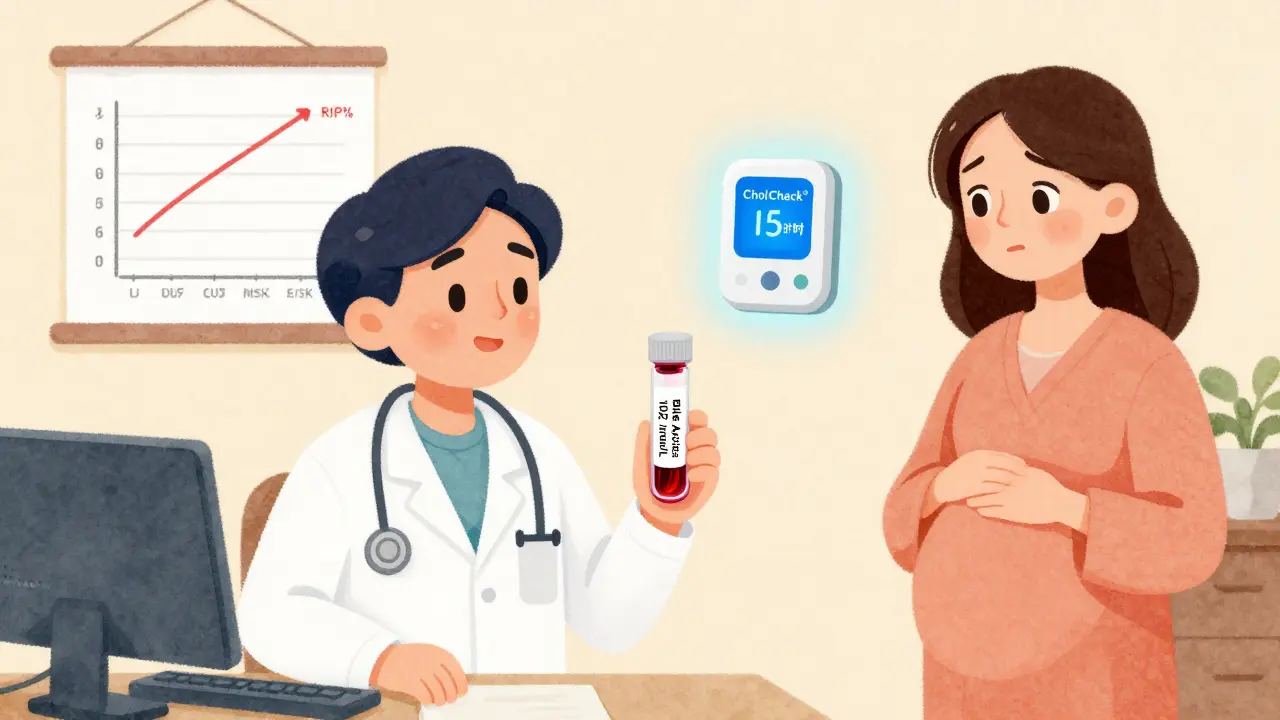
Now, there’s a new tool called CholCheck® - a point-of-care test that gives results in 15 minutes instead of waiting 2 to 3 days for lab results. It’s already in use in most high-risk maternity hospitals in the U.S. If your doctor doesn’t offer it, ask. Early diagnosis saves lives.
Why Is It Dangerous for the Baby?
ICP doesn’t usually hurt the mother much beyond the itching. But for the baby, it’s serious. High bile acid levels can trigger early labor, cause fetal distress, or even lead to stillbirth. About 30% to 60% of women with ICP go into labor early, especially if bile acids are high and the diagnosis comes late.
Stillbirth risk isn’t random. It’s tied directly to bile acid levels. If your levels are under 40 µmol/L and you’re being monitored, the risk stays below 0.5%. But if levels climb above 100 µmol/L without intervention, the risk triples. That’s why doctors don’t wait. They start monitoring your baby closely - usually with non-stress tests twice a week starting at 32 to 34 weeks.
Some women are told to wait until 39 weeks. That’s not safe with ICP. The Royal College of Obstetricians and Gynaecologists recommends delivery at 37 to 38 weeks for mild cases and as early as 34 to 36 weeks for severe cases. Timing delivery isn’t about convenience - it’s about reducing the chance of your baby dying in the womb.
What Treatments Are Safe During Pregnancy?
The first-line treatment for ICP is ursodeoxycholic acid (UDCA). It’s a bile acid that’s been used for decades to treat liver conditions. In pregnancy, it’s given at 10 to 15 mg per kilogram of body weight per day. Studies show it reduces itching by about 70% and may lower the risk of preterm birth by 25%.
Some people worry about using medication during pregnancy. But UDCA is not just safe - it’s the standard of care. It doesn’t cross the placenta in significant amounts, and decades of use show no harm to babies. The Cochrane Review says we don’t yet have proof it reduces stillbirths, but every expert I’ve spoken to agrees: when bile acids are high, UDCA is the best tool we have to buy time and reduce stress on the baby.
If you can’t take UDCA, there’s a second option: S-adenosyl methionine (SAMe). It’s a natural compound found in the body. Small studies show it helps with itching, but the evidence isn’t as strong. It’s not FDA-approved for ICP, but some doctors use it as a backup.
Cholestyramine is sometimes used, but it’s not ideal. It can interfere with vitamin K absorption, which increases the risk of bleeding after delivery. It also causes constipation and bloating, which are already common in pregnancy. Most doctors avoid it unless nothing else works.
What About Natural Remedies?
There’s no scientific proof that oatmeal baths, coconut oil, or herbal teas cure or even reliably reduce ICP symptoms. Some women swear by them, and if they help you sleep better or feel calmer, that’s fine. But they won’t lower your bile acid levels. And that’s what matters most.
Don’t let well-meaning friends or online forums convince you to skip medical care. ICP isn’t like morning sickness - you can’t just ride it out. If you’re itching badly, you need a blood test. No home remedy replaces that.
What Happens After Delivery?
The good news? ICP goes away fast. In 95% of cases, itching disappears within 1 to 3 days after your baby is born. Bile acid levels drop back to normal, and your liver function returns to normal too.
But ICP doesn’t just vanish without a trace. Women who’ve had it are 3.2 times more likely to develop gallstones, chronic liver disease, or hepatitis later in life. That’s why it’s important to tell your primary care doctor about your ICP history. You may need periodic liver checks as you get older.
And if you plan to have another baby, know that you’re very likely to get ICP again. Talk to your OB-GYN early. Ask about starting UDCA sooner in your next pregnancy - some studies show that early treatment improves outcomes even more.

What Should You Do If You Think You Have ICP?
- Don’t ignore the itching. If it’s worse at night, on your hands or feet, and doesn’t improve with lotion, get it checked.
- Ask for a serum bile acid test. Don’t wait for your next appointment. If your doctor says, “It’s just pregnancy,” ask for the test anyway.
- If diagnosed, get referred to a maternal-fetal medicine specialist. They know how to manage ICP.
- Start UDCA right away if recommended. Don’t delay.
- Get twice-weekly non-stress tests from 32 to 34 weeks.
- Plan delivery between 37 and 38 weeks - or earlier if bile acids are high.
- Keep track of your baby’s movements. If you notice a drop, call your doctor immediately.
What’s Changing in ICP Care?
There’s new hope on the horizon. Researchers are testing drugs that block autotaxin, an enzyme linked to itching in ICP. Early trials show a 68% drop in itch severity. That could mean better comfort without medication side effects.
Also, a new international guideline is coming in mid-2024. It’s expected to say that if you’re on UDCA and your bile acids are under 40 µmol/L and trending down, you might not need to deliver at 37 weeks. You could wait until 38 - if monitored closely. That could reduce unnecessary preterm births without risking your baby.
But not everywhere has access to this level of care. In places without regular bile acid testing, doctors have to guess based on symptoms alone. That’s dangerous. If you live in a rural area or a country with limited resources, push for the test. Your baby’s life depends on it.
Final Thoughts
ICP is scary, but it’s manageable. It’s not your fault. It’s not something you did or didn’t do. It’s a biological twist of pregnancy hormones and genetics. The key is early detection and following through with care. You’re not alone - thousands of women go through this every year and deliver healthy babies.
Don’t wait for your doctor to bring it up. If you’re itching, speak up. Ask for the test. Know your numbers. Take the treatment. Trust the science. And remember - your baby’s safety isn’t about luck. It’s about action.





Damario Brown
January 13, 2026 AT 22:40Nelly Oruko
January 14, 2026 AT 14:52Robin Williams
January 15, 2026 AT 16:30Scottie Baker
January 17, 2026 AT 11:18Anny Kaettano
January 17, 2026 AT 18:57Kimberly Mitchell
January 18, 2026 AT 20:24Angel Molano
January 18, 2026 AT 23:13Vinaypriy Wane
January 19, 2026 AT 03:59Diana Campos Ortiz
January 20, 2026 AT 09:10Jesse Ibarra
January 20, 2026 AT 20:38laura Drever
January 20, 2026 AT 20:54jefferson fernandes
January 22, 2026 AT 08:50